

Fantastic team. They took ownership of the project. As a result, they gave very good creative inputs to improve the ad. They also tried hard to reduce the project cost... Read Ehtesham Ahmed's Full ReviewRead More
International Production Support in Bangladesh: What Foreign Production Companies Need to Know (2026)
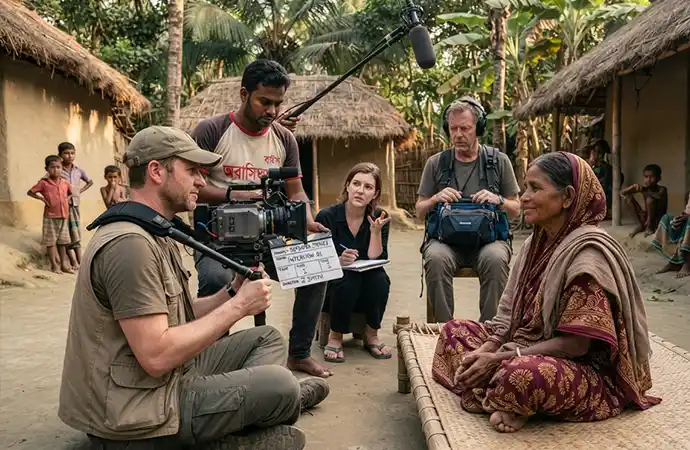
International production support in Bangladesh covers every element of a foreign shoot that cannot be managed from overseas, including permits, crew, equipment, locations, authority coordination and on-ground logistics. This guide explains what the service actually includes, how to evaluate a production support partner, what it costs, and what separates a genuine production service company from a fixer with a phone.
What International Production Support Actually Means
The phrase is used loosely across the industry. For some productions it means a film fixer who arranges permits and shows up on set. For others it means a full line production service where the local partner takes responsibility for everything from the first location recce to the delivery of rushes. Understanding which service you actually need, and which your Bangladesh partner is actually capable of delivering, is the most important decision you will make before committing to a shoot here.
At its broadest, international production support in Bangladesh means the local infrastructure that makes a foreign crew's shoot possible. That infrastructure has several distinct layers:
Access and Permissions Layer
Government filming permits, Ministry of Information clearances, location-specific authority approvals, journalist visa invitation letters and restricted-area permits for CHT, port, ship-breaking yards or humanitarian zones. Without this layer, a foreign crew cannot legally film in most significant locations.
Logistics and Infrastructure Layer
Transport, accommodation, location scouting, community liaison, security coordination, equipment rental and all the operational machinery that keeps a shoot moving. Most international crews underestimate how much local knowledge is required to access this infrastructure efficiently.
Human Resources Layer
Local cinematographers, camera assistants, sound recordists, gaffers, production assistants, translators, fixers and drivers. The quality of local crew is often the single biggest determinant of whether a Bangladesh production delivers what was planned in pre-production.
Creative and Editorial Layer
For productions that want more than logistics, including script input, location development, editorial advice, local story context and production direction. This is the layer that distinguishes a full line producer from a logistics coordinator, and a production service company from a fixer operation.
Most international productions need all four layers. The question is which ones you bring from your home base and which ones you hire locally. A BBC documentary unit arriving with its own director, camera operator and sound recordist needs layers one and two from a local partner. An independent production company arriving with only a director needs all four.
Film Fixer vs Production Support Company vs Line Producer: The Distinctions That Matter
These three terms are used interchangeably in Bangladesh but they describe genuinely different services. Knowing the difference protects your production budget and prevents the most common Bangladesh shoot failure, which is arriving expecting a production company and finding a fixer, or vice versa.
Film Fixer
Access and logistics specialist
Arranges permits, manages access to locations, coordinates with authorities and solves on-ground problems. Does not provide crew, equipment or creative input. Your team leads the shoot and the fixer makes it legally and logistically possible.
Best for: Crews with their own key technical staff who need Bangladesh-specific access and authority management.
Production Support Company
Full local production infrastructure
Everything a fixer does, plus local crew, equipment, transport, accommodation and production coordination. Your international team provides creative direction and the production support company provides the entire operational platform your shoot runs on.
Best for: Production companies arriving with a director and key creative but needing a full local operation built around them.
Line Producer
End-to-end production execution
Takes responsibility for the full local production under the international client's creative brief, including budgeting, scheduling, crew management, permits, locations, equipment, logistics and delivery. The commissioning company receives a finished, delivered production.
Best for: International clients who want to commission Bangladesh content without deploying their own team on the ground.
Libanza Films operates across all three models. The engagement is structured around what the international client actually needs, not a fixed service menu. Productions that start as fixer engagements often expand into hybrid or full line production once the client understands what local capacity is available.
What a Full Production Support Brief Should Cover
The single biggest cause of underperforming Bangladesh productions is an incomplete brief sent to the local partner. A local production support company cannot quote accurately, plan access correctly or staff the shoot appropriately without specific information. Here is what a well-formed brief for Bangladesh production support should include:
- Production type and format: Documentary, news, NGO comms, commercial or corporate, and where it will be distributed such as broadcast, online or internal use. This affects permit language, community access approach and crew briefing.
- Specific locations: Not just Dhaka and Cox's Bazar but which parts of each, such as government buildings, slums, factories, beaches, camps or ports. Every location type has a different access and permit requirement.
- Crew arriving from overseas: Who is coming, what they are bringing such as camera, sound and lighting kit, and what visas they hold or need. This determines what equipment needs to be sourced locally and what invitation letters are required.
- Shoot duration and schedule: Total shooting days, planned move days, and whether there are hard broadcast or delivery deadlines driving the timeline.
- Subject access requirements: Whether you are filming private individuals, government officials, NGO beneficiaries, community leaders or industrial operations. Each has a different consent and access protocol.
- Budget range: An honest indication of the production budget allows a local partner to recommend the right crew level, equipment package and accommodation tier rather than quoting aspirationally and adjusting later.
- Sensitive content flags: If the production involves refugees, humanitarian zones, political figures, security-adjacent locations or contested narratives, say so upfront. These require a different approach from the first planning call.
Libanza Films provides a structured pre-production questionnaire to international clients at the briefing stage, covering all of the above and returning a full access assessment, permit timeline and itemised cost estimate within five working days.
What International Production Support Costs in Bangladesh (2026)
Production support costs in Bangladesh are not fixed. They depend on engagement type, duration, crew size and the access complexity of the planned locations. The following ranges are based on productions Libanza Films has directly supported.
Fixer-Only
USD 2,000 to 8,000
Permits, authority coordination, access management and on-ground fixer presence. Your crew, your direction. We handle everything that requires local relationships and Bangladesh-specific knowledge.
Hybrid Support
USD 5,000 to 15,000
Fixer services plus local DP, camera, sound and production staff. You bring your director and key creative and we build the local operation around them. Most commonly used by documentary and broadcast productions.
Full Line Production
USD 8,000 to 25,000+
We execute the entire shoot on your brief, from pre-production planning and permits through to filming and delivery. The international client provides creative direction and Libanza Films manages the full local operation.
All cost estimates from Libanza Films are itemised. Permit fees, crew day rates, equipment, transport, accommodation and fixer fees are listed separately so international clients can see exactly what they are paying for and adjust the scope accordingly. There are no bundled packages and no hidden markups.
How to Evaluate a Bangladesh Production Support Partner
The Bangladesh production services market includes a wide range of operators, from experienced internationally-connected production companies to individuals describing themselves as fixers with limited infrastructure and no track record of permits. These questions separate credible partners from risky ones:
- Can they show permit approvals from previous productions? A genuine production support company has a documented permit track record. Verbal claims of good government connections without evidence should be treated with caution.
- Do they provide itemised cost breakdowns? Reputable partners provide line-item budgets. Bundled quotes with no breakdown make it impossible to assess whether you are paying fair rates for each element.
- What happens when something goes wrong on set? Ask specifically how they have handled access refusals, permit delays, location conflicts or crew problems on previous shoots. The answer reveals operational experience that a pitch document cannot.
- Do they understand your production's editorial requirements? A production support company supporting an NGO humanitarian film needs to understand informed consent protocols, safeguarding requirements and community sensitivity in a way that a commercial fixer may not.
- Are they a registered Bangladesh entity? Journalist visa invitation letters and some government permits require the inviting organisation to be a registered Bangladesh company. Individual fixers cannot issue these.
- Can they provide references from comparable international productions? Not general client testimonials, but specifically from productions of a similar type, scale and location requirement to yours.
How Libanza Films Works as an International Production Support Partner
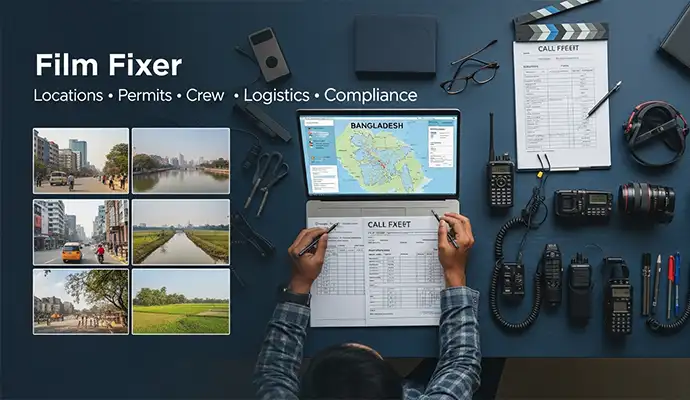
Libanza Films has provided international production support for crews from the USA, UK, Belgium, Romania, Malaysia, Ecuador, Singapore, UAE, France and India, across documentary, broadcast, commercial and NGO production formats. The company was founded in 2018 by Azizul Hoque Shiplu, who has worked in commercial film production and advertising since 2007 and holds a diploma from the Zahir Raihan Film Institute.
Our production support process works as follows:
- Brief and access assessment (Week 1): We review the production brief, identify every location's specific permit and access requirement, flag any sensitive content issues, and return a full written access assessment with honest timelines. No surprises after budget commitment.
- Permit and access initiation (Weeks 2 to 6 plus): All permit applications, authority liaison and access negotiations begin immediately, timed to be completed before crew arrival. Permit status is reported to the international client weekly.
- Pre-production confirmation (2 weeks before shoot): All permits confirmed, crew contracted, equipment reserved, transport and accommodation booked, location recce completed. International crew receives a full production pack before travel.
- On-ground support throughout the shoot: A Libanza Films production representative is present every shoot day, managing access, resolving problems and keeping the schedule on track.
- Post-shoot support: Equipment return, location clearances, data transfer and any post-production coordination required by the international production.
International Productions Libanza Films Has Supported
The following are examples of international production support engagements Libanza Films has managed directly:
USA
Joshua Chronicles
Street documentary production in Dhaka. Full production support including
filming permits, local crew, location access and logistics coordination
throughout the shoot.
UAE, BROADCAST
Al Arabiya News
Ongoing international broadcast fixer support for Bangladesh news
collection based in Dhaka. Daily coordination for a 24/7 international
news channel.
ECUADOR
María José
Independent audiovisual producer, documentary filmed at Cox's Bazar.
Full production support including location access, logistics and local
crew coordination.
For the complete overview of international productions Libanza Films has supported, visit the Film Fixer in Bangladesh service page.
Where Libanza Films Provides International Production Support
Libanza Films provides production support across Bangladesh, not only in Dhaka. Each location carries specific access and permit requirements that differ significantly from standard Dhaka shooting:
- Dhaka: Political and economic capital. Government institutions, corporate headquarters, urban environments, river ghats and factories. General permit takes 10 to 21 working days and sensitive sites add 1 to 2 weeks.
- Cox's Bazar: World's longest natural sea beach, humanitarian zones and Rohingya camp access requiring RRRC permit with 2 to 3 weeks additional prep. Marine logistics and coastal authority coordination.
- Sundarbans: UNESCO World Heritage mangrove forest. Forest Department permit takes 4 to 6 weeks, with armed guard coordination and boat-based logistics throughout.
- Chittagong (Chattogram): Ship-breaking yards require 4 to 6 weeks of owner negotiation. Chittagong Port Authority permission and Chittagong Hill Tracts foreign national special area permit takes 6 to 8 weeks minimum.
- Sylhet: Tea estates take 3 to 4 weeks for owner negotiation. Ratargul Swamp Forest permit takes 4 to 6 weeks. Haor wetlands require seasonal logistics and UK-Bangladeshi diaspora production experience.
Multi-location productions are coordinated under a single support plan. No need to manage separate local partners across different regions.
Frequently Asked Questions, International Production Support Bangladesh
International production support in Bangladesh covers permits, visa guidance, location scouting, local crew hiring, equipment sourcing, transport, accommodation, authority coordination and on-ground supervision, everything a foreign crew cannot manage from overseas.
A film fixer handles access, permits and logistics for a crew that brings its own creative and technical team. A production support company does all of that and provides local crew, equipment, direction, and full-line production. Libanza Films offers both, scaled to the international production's actual needs.
Fixer-only support starts from USD 2,000 to 8,000. Hybrid support with a fixer plus local crew and equipment runs USD 5,000 to 15,000. Full-line production partnership starts from USD 8,000 to 25,000 and above, depending on duration, crew size and locations. See the full film fixer cost guide for Bangladesh.
A minimum of 6 to 8 weeks for most productions. Shoots involving restricted locations such as the Chittagong Hill Tracts (6 to 8 weeks for the mandatory special area permit), ship-breaking yards (4 to 6 weeks for owner negotiation) or Rohingya camp zones (2 to 3 weeks for the RRRC permit) require 10 to 12 weeks total lead time from brief to shoot date.
Yes. Libanza Films provides full-line production services for international productions, managing the entire local operation from pre-production planning through to shoot delivery, under the creative direction of the international production company.
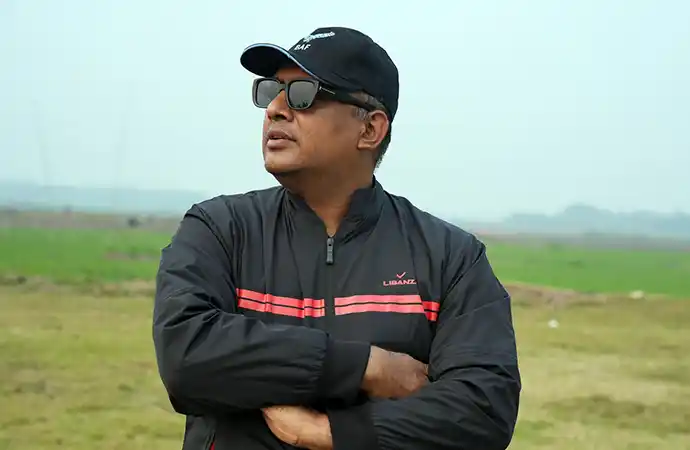
About the Author
Azizul Hoque Shiplu
Founder and Film Director of Libanza Films. Azizul has worked in commercial film production and advertising since 2007, beginning his career at Ogilvy and Mather and training at the Zahir Raihan Film Institute. He has personally managed international production support engagements for crews from the USA, UK, Belgium, Romania, Malaysia, Ecuador, Singapore, UAE, France and India — including ongoing broadcast partnerships with Al Arabiya News (UAE) and line production work with RagingNation Films, Los Angeles. The service descriptions, permit timelines and evaluation criteria in this guide reflect direct experience managing international productions in Bangladesh across all formats and locations.
Related Reading
- Film Fixer in Bangladesh — Full Service Overview and Pricing
- Film Fixer in Dhaka — Permits, Old City Access and Broadcast News
- Film Fixer in Cox's Bazar — RRRC Permits, Coastal and Camp Productions
- Film Fixer in Sundarbans — Forest Permits, Boat Logistics and Wildlife
- Filming Permits and Media Visa Guidance in Bangladesh
- How to Hire a Film Fixer in Bangladesh: The Complete Guide (2026)
- Drone Filming Permits in Bangladesh: Complete Guide (2026)
- Filming in Bangladesh from the UK and USA: Guide for Diaspora Filmmakers (2026)
- How Much Does a Film Fixer Cost in Bangladesh? (2026 Guide)
- Filming Permits in Bangladesh Explained: Step-by-Step Guide for Foreign Crews
- Filming Costs in Bangladesh: Budget Guide for International Productions (2026)
- NGO and Documentary Filming in Bangladesh: What Foreign Teams Should Know
- International Shoot in Bangladesh: 2026 Filming Guide
- Cox's Bazar as a Filming Destination: Complete Guide for Foreign Crews (2026)
Ready to Plan Your Bangladesh Production?
Share your production brief including dates, locations, crew size and format. Libanza Films will return a full access assessment, permit timeline and itemised cost estimate within five working days.
Customer Reviews

Very dedicated team! Apprecite their enthusiasm, creativity and passion for their work... Read Md. Jamil Hossain Chowdhury Rahat's Full ReviewRead More


Libanza specializes in creating captivating films and advertisements with compelling narratives and stunning visuals... Read Riad Full ReviewRead More
Get in Touch
Our Clients
Diverse industries, trusted partnerships. From advertising agencies to corporate entities and non-profit organizations, our clients rely on us to bring their creative visions to life. With passion, expertise, and attention to detail, we deliver exceptional video production solutions that exceed expectations. Join our esteemed clientele and experience the power of captivating storytelling with Libanza Films.