Fantastic team. They took ownership of the project. As a result, they gave very good creative inputs to improve the ad. They also tried hard to reduce the project cost... Read Ehtesham Ahmed's Full ReviewRead More
Filming Costs in Bangladesh: Budget Guide for International Productions (2026)
Short answer: a film fixer in Bangladesh costs USD 2,000 to 8,000 for fixer-only support, USD 5,000 to 15,000 for hybrid support with local crew and equipment, and USD 8,000 to 25,000 and above for full line production. Individual fixer day rates run USD 150 to 300 for an experienced coordinator. See what each package includes.
Bangladesh is one of the most cost-effective countries in the world to produce high-quality documentary, commercial and factual content — but "cost-effective" is a phrase that means very little without numbers behind it. Production managers, executive producers and commissioning editors planning Bangladesh shoots need actual budget figures: what a fixer costs per day, what local crew day rates look like, what equipment rental runs to, what accommodation and transport will consume.
This guide provides transparent, current (2026) cost ranges across every major budget line for international productions filming in Bangladesh. The figures are approximate market ranges — not quotes — and actual costs depend on the scope, duration, locations and production standards of each specific project. But they are honest, based on real Bangladesh production experience, and designed to give you a working budget framework rather than a vague answer.
All figures in this guide are in USD. Bangladesh taka equivalent values fluctuate with exchange rates — your local production partner should provide taka-denominated supplier costs and a confirmed exchange rate in any formal quote.

Filming Costs in Bangladesh at a Glance (2026)
| Budget line | Typical cost (USD) |
|---|---|
| All-in daily cost, minimal documentary crew | 400–700 per day |
| All-in daily cost, mid-size crew (5–8 people) | 1,500–3,500 per day |
| Experienced fixer | 150–300 per day |
| Fixer-only / hybrid / full line production package | 2,000–8,000 / 5,000–15,000 / 8,000–25,000+ |
| Local DP / cinematographer | 150–500 per day |
| Cinema camera body (FX6 / FX9) | 100–200 per day |
| Mid-range hotel, Dhaka | 80–150 per night |
| Car and driver, Dhaka | 50–80 per day |
| Ministry of Information permit fee | BDT 5,000–15,000 (about 45–135) |
| 5-day documentary in Dhaka (sample budget) | 3,575–5,445 total |
All figures exclude international flights. Detailed ranges and what drives them are below.
How Production Costs Are Structured in Bangladesh
International productions in Bangladesh typically budget across five categories. Understanding which categories dominate your specific production type helps prioritise where to invest and where flexibility exists.
- Fixer and production management fees — the cost of the local coordinator or line producer who manages everything else. This is the most leverage-sensitive budget line: a good fixer saves you more in avoided problems than their daily rate costs.
- Local crew day rates — cinematographer, camera assistant, sound recordist, gaffer, production assistants, driver and any additional specialist crew required by the production.
- Equipment rental — camera bodies and lenses, lighting, audio packages, grip, drone, monitors and playback.
- Logistics — accommodation, transport (city vehicles, inter-city travel, domestic flights, boat hire for remote locations), meals and per diem for the local crew.
- Permits and administrative costs — government filming permits, site-specific permissions, media visa invitation letters and related facilitation.
For most international documentary and factual productions, fixer fees and local crew account for 40–55% of the total Bangladesh budget. Equipment and logistics split the remainder roughly equally, with permits typically representing a small but timeline-critical fixed cost.
Film Fixer Costs in Bangladesh (2026)
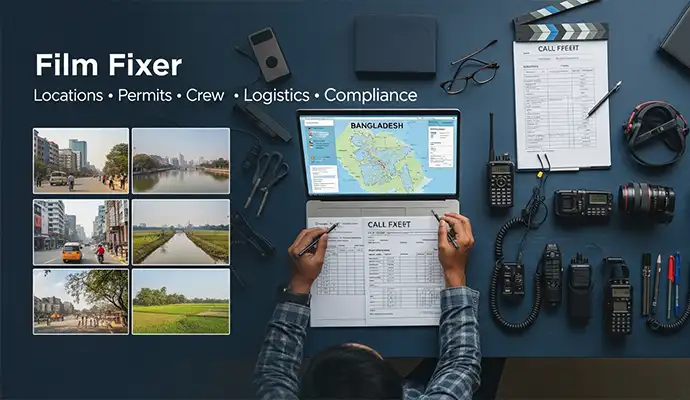
Film fixer day rates in Bangladesh vary based on experience level, English fluency, authority relationships and the complexity of what the production requires. The three tiers operating in the market are:
- Entry-level fixer / production runner — USD $80–$130/day. Basic logistics coordination, Bangla–English translation, local transport facilitation. Suitable for low-complexity shoots in straightforward locations. No established authority relationships; limited capacity for permit facilitation or problem-solving.
- Experienced fixer / production coordinator — USD $150–$300/day. Established government and location relationships, strong English communication, permit facilitation experience, international workflow familiarity. The appropriate level for most documentary, broadcast and NGO productions.
- Senior production manager / line producer — USD $300–$500/day. Full production management capability — budget management, crew coordination, broadcaster compliance experience, multi-location scheduling and senior authority liaison. Required for large commercial productions, multi-city shoots and broadcaster-commissioned documentary work with compliance requirements.
The most common mistake international productions make is hiring the cheapest fixer available and discovering mid-shoot that the permit relationships, English communication and problem-solving capacity simply are not there. A mid-tier fixer at $200/day who prevents one day's shoot from collapsing saves more than the $70 saved by hiring at the entry level.
Most fixer engagements carry a minimum of 3 to 5 days, regardless of shoot length, to cover the pre-production permit and logistics work. For anything beyond a short Dhaka shoot, project-based pricing is more common and more transparent than a day rate — see the packages below.
Fixer Support Packages: Fixer-Only, Hybrid and Full Line Production
The biggest source of price variation in Bangladesh fixer quotes is not the fixer's day rate. It is which engagement model you are buying. These three models are genuinely different services with different cost structures.
Model 1
Fixer-Only
USD 2,000 – 8,000
Your crew, your direction, your equipment. The fixer makes the shoot legally and logistically possible.
Included
- Ministry of Information permit coordination
- Location-specific authority liaison
- Journalist visa invitation letters
- On-ground fixer presence throughout the shoot
- Real-time access management and troubleshooting
Not included: permit fees, crew, equipment, transport, accommodation.
Model 2 · Most common
Hybrid Support
USD 5,000 – 15,000
You bring the director and key creative. Libanza Films builds the local crew, kit and coordination around your team.
Included
- Everything in fixer-only
- Local cinematographer and sound recordist
- Production assistant and translator
- Camera and audio equipment package
- In-country transport and driver
Not included: permit fees, accommodation, international flights.
Model 3
Full Line Production
USD 8,000 – 25,000+
You commission and brief. Libanza Films runs the entire local operation, from pre-production to delivery.
Included
- Pre-production planning and permit management
- Director, local DP, sound and production staff
- All equipment, transport and accommodation
- Post-production coordination and delivery
- Single point of contact throughout
Not included: international travel for the client's own team.
Productions at the lower end of each range typically run 2 to 3 shooting days in standard Dhaka locations with a crew of 2 to 4. Productions at the upper end run 7 to 14 shooting days across several regions (Dhaka plus Cox's Bazar or the Sundarbans, for example) with a crew of 8 to 15. Fixer service fees are not the same as total production cost — permit fees, crew, equipment, transport and accommodation are itemised separately, as set out in the sections below.
Local Crew Day Rates in Bangladesh (2026)
Bangladesh has a growing pool of professionally trained local crew across all core production roles. The following are approximate day rate ranges for experienced crew working on international productions:
- Cinematographer / Director of Photography
USD $150–$500/day. Rate reflects experience level and camera system fluency. DPs comfortable with ARRI, RED and Sony cinema systems are available in Dhaka at the higher end of this range. - Camera Assistant (1st AC)
USD $60–$120/day. - Sound Recordist
USD $80–$150/day. Includes personal audio kit in most arrangements; confirm whether production equipment rental is additional. - Gaffer / Chief Lighting Technician
USD $80–$140/day. - Drone Pilot (licensed)
USD $120–$250/day. Rates vary significantly based on drone system (DJI Mavic vs. cinema drone), whether the pilot supplies their own equipment and permit coordination requirements.
- Production Assistant
USD $40–$80/day. - Bangla–English Translator / Interpreter
USD $60–$120/day. For productions requiring simultaneous interpretation during interviews, rates are higher. - Driver (with vehicle)
USD $50–$80/day including a standard vehicle. SUVs, minibuses and specialist off-road vehicles for remote locations are priced separately. - Makeup and Wardrobe (commercial productions)
USD $60–$120/day. - Art Director / Set Dresser
USD $80–$150/day for commercial and branded content productions.
Important note on crew rates: Bangladesh crew day rates typically cover an 8-10 hour working day. Overtime is standard practice for international productions running longer days — agree rates in advance. Meal provision during shoot days is standard practice and should be costed into the logistics line.
Equipment Rental Costs in Bangladesh (2026)
Professional production equipment is available for daily or weekly rental in Dhaka. The following are approximate daily rental rates for the most commonly requested packages:
- Cinema camera (Sony FX6 / FX9 / VENICE)
USD $100–$200/day body only. Lens packages priced separately. - High-end cinema camera (ARRI Alexa Mini / RED Komodo)
USD $300–$500/day. Confirm specific model availability 4–6 weeks out. - Prime lens set (cinema primes)
USD $100–$200/day for a set of 4–5 primes. - Gimbal stabiliser (professional grade)
USD $60–$100/day. - DJI cinema drone (Inspire 2 / Air 3)
USD $150–$280/day for equipment only. Operator day rate is additional.
- Professional LED lighting package (3–5 heads)
USD $80–$160/day. - Portable interview lighting kit
USD $40–$80/day. Suitable for run-and-gun documentary work. - Professional audio package (recorder + boom + lavs)
USD $60–$110/day. - Monitor and playback setup
USD $40–$80/day. - Generator (for remote location power)
USD $50–$100/day depending on capacity. Essential for Sundarbans and rural shoots.
Weekly rental rates typically represent a 30–40% discount on daily rates for equipment held throughout a production. For productions of five days or more, negotiate weekly terms at the outset. All equipment listed above is available from rental suppliers in Dhaka — availability outside the capital requires transport from Dhaka, which adds logistics cost and a one-day transit buffer to your schedule.
Accommodation Costs in Bangladesh for Production Crews
Bangladesh's accommodation market for international crews ranges from practical guesthouses to international business hotels. Location significantly affects availability and pricing.
- Dhaka — budget guesthouse / service apartment: USD $35–$65/night. Reliable Wi-Fi, AC, acceptable security. Suitable for productions where accommodation is sleeping-only and the crew is on location all day.
- Dhaka — mid-range business hotel: USD $80–$150/night. International business hotel standards, reliable facilities, suitable for production base operations. Gulshan, Banani and Baridhara areas recommended for proximity to diplomatic zone, international offices and good road access.
- Dhaka — international standard hotel (Westin, Radisson, Le Méridien): USD $150–$280/night. Required for senior personnel, broadcaster representatives or productions with specific duty-of-care accommodation standards.
- Cox's Bazar: USD $50–$130/night mid-range. International standard hotel options exist; book significantly in advance for peak season (November–February) when domestic tourism fills the better properties.
- Sylhet, Chittagong, Khulna (Sundarbans base): USD $40–$100/night mid-range. The international hotel tier drops sharply outside Dhaka — plan accordingly for productions requiring extended stays in secondary cities.
Transport and Logistics Costs in Bangladesh
- Car and driver — Dhaka city: USD $50–$80/day for a standard sedan with driver. Suitable for 1–2 crew members. Note: Dhaka traffic makes per-trip estimates unreliable — day hire is standard for productions.
- Microbus / minibus — Dhaka city or inter-city: USD $80–$150/day depending on vehicle size (6–12 passenger). Standard for crew transport on multi-person shoots.
- 4WD / SUV for rural and remote locations: USD $100–$180/day. Required for monsoon-season rural shoots, char island access roads and off-highway locations.
- Domestic flights (one way, per person): USD $45–$90. Dhaka to Cox's Bazar, Sylhet or Chittagong. Prices vary with advance booking — purchase 4 weeks out for best availability. Excess baggage for production equipment is a separate cost: negotiate a group equipment tariff directly with the airline.
- Boat hire — Sundarbans and river delta work: USD $80–$200/day for a mechanised wooden launch suitable for 4–8 people. Overnight vessels with cabin accommodation: USD $200–$400/day. Forest Department guide: approximately USD $30–$60/day and mandatory for tiger zone.
- Intercity road hire (Dhaka to Khulna, Dhaka to Sylhet, etc.): USD $100–$180 per vehicle one way, 5–7 hour journey. Return fare is typically negotiated as part of the full hire.
Filming Permit and Administrative Costs in Bangladesh
Government filming permits in Bangladesh are not always expensive — but the facilitation cost of obtaining them through a production partner with the right relationships is a real budget line. The following covers the cost landscape rather than official fee schedules, which change periodically.
- Ministry of Information filming clearance: The government application fee runs approximately BDT 5,000–15,000 (about USD $45–$135) and is passed through at cost. Processing takes 10–21 working days. Facilitation through a production partner — covering application preparation, liaison, follow-up and expediting — ranges USD $100–$300 depending on complexity and lead time.
- Media / journalist visa invitation letters: Typically included within a full production support package. As a standalone service: USD $50–$100 per letter.
- Sundarbans Forest Department permit: Entry fees: approximately USD $25–$60 per person for the standard tourist zone. Extended documentary/film permit: USD $100–$300. Forest guard (mandatory): USD $30–$60/day.
- Chittagong Hill Tracts special permit: Facilitation cost: USD $80–$150 per person depending on nationality and district. Allow 6–8 weeks.
- Site-specific permits (hospitals, factories, government buildings): Widely variable — from nominal fees paid directly to the institution to facilitation costs of USD $200–$500 for complex negotiated access to industrial or restricted sites. Ship-breaking yard access in Sitakunda is negotiated directly with yard owners, typically USD $100–$500 per yard per day.
- Equipment customs carnet / temporary import facilitation: USD $100–$200 for documentation support. Highly recommended for productions bringing professional camera equipment from abroad — avoiding confiscation on arrival is worth multiples of this cost.
Other Cost Lines to Budget For
Beyond the fixer, crew, equipment, accommodation, transport and permits, a complete Bangladesh budget usually needs these lines. Leaving them out is the most common reason a quote looks cheaper than the final bill.
- Post-production in Bangladesh
Offline editing USD $100–$250/day; colour grading USD $150–$350/day; sound mix quoted per finished minute. Optional — many productions edit at home. - Transcription and subtitling
Bangla–English transcription and translation of interview footage, roughly USD $3–$8 per minute of recorded footage. Budget early for interview-heavy documentaries. - Talent and extras (commercial shoots)
Extras USD $15–$40/day; featured actors and models USD $150–$600/day plus usage rights; casting sessions quoted per project. - Location fees
Private homes, shops, offices and restaurants typically USD $50–$300/day; hotels, malls and premium venues more. Public spaces need permits rather than fees. - Community and interviewee costs
Refreshments, transport or compensation for participants' time, typically modest per person; agreed in advance and handled ethically, especially for NGO work.
- Security and police liaison
Recommended for crowds, sensitive locations or high-value kit; typically USD $50–$150/day depending on arrangement. - Data management (DIT)
Data wrangler USD $80–$150/day, plus backup drives purchased locally or brought from home. - Local SIMs and data
Inexpensive — a few US dollars per crew member — but essential for coordination; your fixer can arrange them on arrival. - Per diems outside Dhaka
Meals and incidentals for local crew travelling outside Dhaka, typically USD $10–$25 per person per day. - Standby and overtime
Weather standby days are usually charged at a reduced crew rate; overtime beyond a 10-hour day is charged hourly. Agree both in writing. - Insurance
Production, equipment and crew insurance is normally arranged by the international production in its home country. - Taxes
Libanza Films quotes exclude VAT and AIT, which are added as required by Bangladesh regulations and shown separately.
Permits, Lead Time and Complexity by Region
Location is the second biggest cost variable after the engagement model. Each region adds its own permits, lead time and coordination effort on top of a base Dhaka production. Transport costs for each region are covered in the transport section above.
| Region | Permits needed | Typical lead time | Complexity |
|---|---|---|---|
| Dhaka (standard zones) | Ministry of Information only | 10–21 working days | Moderate |
| Dhaka (sensitive zones: Hazaribagh, Sadarghat, factory interiors) | MoI plus district or police clearance | Add 1–2 weeks | High |
| Cox's Bazar (beach and harbour) | MoI plus coastal administration | Add 1–2 weeks | Moderate to high |
| Cox's Bazar (Rohingya camps) | MoI plus RRRC permit | RRRC: 2–3 weeks | Very high |
| Sundarbans | MoI plus Forest Department | 4–6 weeks | Very high |
| Chittagong (city, port, ship-breaking yards) | MoI plus port or site permission | Add 2–4 weeks | High |
| Chittagong Hill Tracts | MoI plus CHT special permit | 6–8 weeks | Very high |
| Sylhet (tea estates) | MoI plus estate negotiation | Add 2–4 weeks | Moderate |
| Sylhet (Ratargul Swamp Forest) | MoI plus Forest Department | 4–5 weeks | High |
| Any location, with drone | CAAB drone permit (plus area permits) | Yellow zone: 3–4 weeks | High |
For seasons, visas and location planning, see our guide to planning an international shoot in Bangladesh.
Sample Production Budget Estimates for Bangladesh
The following are indicative budget ranges for three common international production types in Bangladesh. These are working estimates — not quotes — based on market rates current at the time of publication. Actual costs depend on specific requirements, locations and production standards.
Example A — Small Documentary, 5 Shoot Days, Dhaka
Solo international filmmaker + 1 local DP + fixer + driver. Filming in Dhaka — Old Dhaka streets, factory access, community interviews. No specialist restricted-area access.
- Experienced fixer (5 days): USD $1,100–$1,500
- Local DP including basic camera kit (5 days): USD $900–$1,500
- Driver and vehicle (5 days): USD $350–$500
- Accommodation — mid-range hotel (5 nights): USD $500–$750
- Permits and facilitation: USD $200–$400
- Meals and crew per diem: USD $200–$300
- Miscellaneous and contingency (10%): USD $325–$495
Estimated total: USD $3,575–$5,445 — excluding international flights and post-production.
Example B — NGO Impact Story Production, 7 Days, Dhaka + Rural District
NGO communications team (2 international) + local DP + fixer + PA + sound recordist + driver. Filming in Dhaka and one rural district (2-day overnight). Multiple community interview locations, health facility access.
- Senior fixer / production coordinator (7 days): USD $1,750–$2,500
- Local DP (7 days): USD $1,200–$2,000
- Sound recordist (7 days): USD $700–$1,000
- Production assistant (7 days): USD $350–$560
- Vehicle and driver (7 days): USD $490–$700
- Rural accommodation — 2 nights: USD $120–$200
- Dhaka accommodation — 5 nights (2 international crew): USD $800–$1,500
- Permits, community liaison facilitation, health facility access: USD $300–$600
- Meals and crew per diem: USD $400–$600
- Miscellaneous and contingency (10%): USD $611–$966
Estimated total: USD $6,721–$10,626 — excluding international flights and post-production.
Example C — Commercial TVC / Branded Content, 3 Shoot Days, Dhaka
Visiting international director + senior local DP + full local crew (camera assist, gaffer, sound, PA, makeup, driver). Professional lighting and camera package rental. Studio and location mix.
- Senior production manager (3 days): USD $1,200–$1,500
- Senior local DP (3 days): USD $750–$1,000
- Camera assistant (3 days): USD $240–$360
- Gaffer (3 days): USD $300–$420
- Sound recordist (3 days): USD $300–$450
- Makeup and wardrobe (3 days): USD $240–$360
- Production assistant x2 (3 days): USD $300–$500
- Cinema camera package rental (3 days): USD $600–$900
- Professional lighting package (3 days): USD $360–$600
- 2 vehicles and drivers (3 days): USD $360–$540
- Location fees and permits: USD $300–$600
- Accommodation — 2 nights (director + 1): USD $300–$600
- Meals and crew catering: USD $300–$450
- Miscellaneous and contingency (10%): USD $555–$833
Estimated total: USD $6,105–$9,113 — excluding international flights, post-production and talent/casting fees.
What Drives Costs Up in Bangladesh
Understanding the cost multipliers helps productions budget more accurately from the outset rather than discovering overruns mid-shoot.
- Duration and minimum engagement: A 3-day Dhaka shoot and a 12-day multi-location shoot on the same engagement model produce very different totals. Most fixer engagements carry a 3 to 5 day minimum to cover pre-production permit and logistics work, regardless of shoot length.
- Number of locations: Each additional region adds transport, a further permit application, new authority relationships and more logistics. A single-city Dhaka production is significantly cheaper than one combining Dhaka, Cox's Bazar and the Sundarbans.
- Crew size: A 2-person news crew needs less vehicle capacity, fewer translators and simpler logistics than a 12-person documentary unit. Crew size directly drives transport, accommodation and production assistant costs.
- Restricted location access: Ship-breaking yards, Rohingya settlements, military areas and the Chittagong Hill Tracts all require additional permit costs, facilitation time and in some cases dedicated security coordination. Each adds USD $200–$600+ to the permit budget line.
- Editorial sensitivity: Productions covering politically sensitive topics, security-adjacent environments or humanitarian zones need a more careful permit approach, more experienced community liaison and closer on-ground management. This shows up in the fixer fee, not just the permit cost.
- Short notice production: Productions confirmed with less than four weeks' lead time require expedited permit processing, rushed visa coordination and first-available equipment rental — all at premium rates. A production confirmed six weeks out versus two weeks out can cost 20–30% more on the permit and logistics lines alone.
- Monsoon season operations: Remote location logistics in the rainy season (June–September) require heavier vehicles, boat access substituting for road access, waterproofing for equipment and contingency days built into the schedule. Add 15–25% to transport and logistics for monsoon-season remote shoots.
- Remote locations (Sundarbans, haor wetlands, coastal chars): Boat hire, generator provision, distance from rental suppliers and the time cost of getting crew and equipment to remote locations add materially to any budget. A Sundarbans shoot costs 40–60% more per day than an equivalent Dhaka shoot at the logistics level.
- International-standard post-production: If Bangladesh-based offline or online editing is part of the production plan, rates are significantly lower than European or North American equivalents — but quality varies significantly. Productions with broadcast delivery requirements should confirm technical specifications in advance.
How Bangladesh Compares to Other International Production Markets
The cost advantage of producing in Bangladesh is real — but it is most pronounced in specific budget lines, not uniformly across everything.
- vs. UK / Western Europe: Local crew day rates in Bangladesh are 70–85% lower than UK equivalents. A London-based documentary DP costs four to five times a Dhaka-based DP at a comparable experience level. Equipment rental is 60–75% lower. Accommodation in Dhaka mid-range is comparable to budget options in London. The cost differential is most meaningful on multi-day, multi-crew productions — the savings compound with each additional shooting day and crew member.
- vs. India: Bangladesh and India are broadly comparable on local crew rates, though Mumbai and Delhi command premiums not present in Dhaka. The regulatory environment in Bangladesh is simpler for certain types of documentary and journalistic content than India's. Bangladesh has meaningful cost advantages for Cox's Bazar/Rohingya content that simply has no India equivalent.
- vs. Southeast Asia (Thailand, Vietnam, Indonesia): Bangladesh local crew rates are generally 20–35% lower than comparable Southeast Asian production markets. Equipment rental is similar. Bangladesh's cost advantage is partly offset for general commercial productions by the greater depth of the commercial production industry in markets like Bangkok or Ho Chi Minh City — but for documentary, factual, NGO and development content, Bangladesh's subject matter, visual landscape and cost structure make it the clear first choice.
The single most important framing for Bangladesh production budgets: the cost savings are most significant when the production commits appropriate lead time. Under-planned Bangladesh shoots become expensive quickly. Well-planned Bangladesh shoots deliver more shooting days, more locations and more usable content per dollar spent than almost any comparable market.
Red Flags in Bangladesh Fixer Quotes
Not every Bangladesh fixer quote reflects genuine pricing. These patterns should prompt questions before you commit:
- Fixer fees bundled with permits, crew and transport: a single opaque number makes it impossible to judge value or compare proposals like-for-like. Ask for every line itemised.
- A permit timeline that does not match reality: the Ministry of Information permit takes 10–21 working days. Be cautious of any quote promising it in 2 to 3 days without explaining how.
- A fixer fee far below the ranges in this guide: it usually means either no genuine authority relationships (and informal rather than official permits), or a low headline fee followed by add-ons for everything the production actually needs.
- Missing cost lines: a quote with no post-production, talent, location fee or per diem lines (where your shoot needs them) will grow once production starts. Check it against the other cost lines above.
- No mention of the RRRC permit for Cox's Bazar camp access: a camp-related quote without it suggests the fixer has not done this work before or has not assessed your brief.
- No named individuals or verifiable track record: you should know who your on-ground fixer will be and be able to check references from comparable international productions.
Frequently Asked Questions — Filming Costs in Bangladesh
A minimal documentary production — one international filmmaker, a local fixer, camera support and driver — typically costs USD 400 to 700 per day in Bangladesh, excluding international flights and pre-production. A mid-size crew of five to eight people with full local crew, equipment, transport and accommodation runs USD 1,500 to 3,500 per day depending on location and equipment requirements. Commercial productions with international-standard crew and multi-location shoots range from USD 3,000 to 10,000 and above per day.
Yes, compared with most international production markets. Local crew day rates in Bangladesh are 70 to 85 percent lower than UK equivalents and typically 20 to 35 percent lower than Southeast Asian markets such as Thailand and Vietnam. The savings are largest on multi-day shoots with significant local crew; they shrink on short-notice productions, which can cost 20 to 30 percent more on permits and logistics.
Yes. Dhaka has the most crew and rental suppliers, so it is usually the cheapest base. Outside Dhaka, accommodation is cheaper (USD 40 to 100 per night mid-range) but equipment must be transported, adding cost and a one-day buffer. Remote locations cost the most: a Sundarbans shoot typically costs 40 to 60 percent more per day than Dhaka at the logistics level, because of boat hire, generators and mandatory forest guards.
An experienced English-speaking film fixer in Bangladesh costs USD 150 to 300 per day depending on experience level, production complexity and access requirements. A senior production manager or line producer with international production experience commands USD 300 to 500 per day. These rates cover coordination time only — transport, permits and accommodation are itemised separately.
A fixer-only engagement in Bangladesh typically costs USD 2,000 to 8,000. Hybrid support, with the fixer plus local crew and a camera and audio package, runs USD 5,000 to 15,000. Full line production runs USD 8,000 to 25,000 and above. The lower end of each range reflects 2 to 3 shooting days in standard Dhaka locations with a crew of 2 to 4; the upper end reflects 7 to 14 shooting days across several regions with a crew of 8 to 15.
A Bangladesh film fixer fee covers Ministry of Information permit coordination, location-specific authority liaison, access management, journalist visa invitation letters and on-ground fixer presence and problem-solving throughout the shoot. It does not include government permit application fees, crew day rates, equipment rental, transport or accommodation, which are listed separately in an itemised budget.
No. Government permit application fees are passed through at cost and listed separately. The Ministry of Information filming permit costs approximately BDT 5,000 to 15,000 (about USD 45 to 135) and takes 10 to 21 working days to process. RRRC permits for Cox's Bazar camp access, Forest Department permits for the Sundarbans and Ratargul, and CAAB drone permits each carry their own fees and timelines.
Yes. Bangladesh is widely used for documentary, journalism and NGO filming because of its climate, river, humanitarian and urban stories, low crew costs and experienced local fixers. A small 5-day documentary in Dhaka typically costs USD 3,575 to 5,445, and a 7-day NGO production across Dhaka and a rural district USD 6,721 to 10,626, excluding flights and post-production.
Bangladesh is generally cost-competitive with India for location-based documentary and factual content, and significantly less expensive than equivalent productions in Western Europe or North America. Local crew day rates in Bangladesh are typically 20 to 35 percent lower than comparable Southeast Asian markets such as Thailand and Vietnam. The cost advantage is most pronounced on productions requiring significant local crew, multiple shoot days and location-heavy logistics.
How Libanza Films Quotes and Bills
Every Libanza Films quote is fully itemised. Fixer fees, permit costs, crew day rates, equipment, transport and accommodation each sit on their own line, so you can see exactly what you are paying for and adjust scope with confidence.
- You share your brief: dates, locations, crew size and format.
- Within 48 hours we send an itemised cost breakdown.
- Within 5 working days we return a full access assessment with honest permit timelines for every location.
- If brief and budget don't align, we recommend specific scope adjustments to bring them together.
- No surprises on the shoot: every cost is confirmed in writing before your crew travels. Permit fees are passed through at cost, with no mark-up; VAT and AIT are shown separately.
About the Author
Azizul Hoque Shiplu
Founder and Film Director of Libanza Films. Azizul has worked in commercial film production and advertising since 2007, beginning his career at Ogilvy and Mather and training at the Zahir Raihan Film Institute. He has personally managed and budgeted international productions for crews from the USA, UK, Belgium, Romania, Malaysia, Ecuador, Singapore, UAE, France and India — across documentary, broadcast, commercial and NGO formats, including ongoing broadcast fixer support for Al Arabiya News (UAE) and production collaborations with RagingNation Films, Los Angeles. The cost figures in this guide are drawn directly from productions Libanza Films has quoted and executed in Bangladesh. They are not estimates sourced from secondary research.
Ready to Budget Your Bangladesh Production?
The figures in this guide give you a working framework — but every production is different, and the most useful number is always the itemised quote for your specific dates, locations, crew size and requirements. Libanza Films provides transparent, fully itemised production cost estimates for international crews filming in Bangladesh — covering every budget line from fixer fees and crew day rates to permits, logistics and accommodation.
Send us your production brief and we will respond with an itemised cost breakdown within 48 hours. No obligation. No vague package pricing.
Related Reading
- Filming in Bangladesh: 2026 Guide for Foreign Crews — Permits, Seasons, Locations
- Film Fixer in Bangladesh — Full National Coverage and Pricing
- Film Fixer in Dhaka — Permits, Old City Access and Pricing
- Film Fixer in Cox's Bazar — RRRC Permits, Coastal and Camp Access
- Film Fixer in Sundarbans — Forest Permits, Boat Logistics and Wildlife
- Film Fixer in Chittagong — Ship-Breaking Yards and Hill Tracts
- Film Fixer in Sylhet — Tea Estates, Haor Wetlands and Swamp Forest
- Filming Permits and Media Visa Guidance in Bangladesh
- How to Hire a Film Fixer in Bangladesh: The Complete Guide (2026)
- Film Fixer vs Production Company: What International Crews Actually Need
- Drone Filming Permits in Bangladesh: Complete Guide (2026)
- Filming in Bangladesh from the UK and USA: Guide for Diaspora Filmmakers (2026)
- Filming Permits in Bangladesh Explained: Step-by-Step Guide for Foreign Crews
- Film Locations in Bangladesh: A Director's Guide for International Productions
- International Production Support in Bangladesh: What Foreign Production Companies Need to Know
- NGO and Documentary Filming in Bangladesh: What Foreign Teams Should Know
Customer Reviews

Very dedicated team! Apprecite their enthusiasm, creativity and passion for their work... Read Md. Jamil Hossain Chowdhury Rahat's Full ReviewRead More


Libanza specializes in creating captivating films and advertisements with compelling narratives and stunning visuals... Read Riad Full ReviewRead More
Get in Touch
Our Clients
Diverse industries, trusted partnerships. From advertising agencies to corporate entities and non-profit organizations, our clients rely on us to bring their creative visions to life. With passion, expertise, and attention to detail, we deliver exceptional video production solutions that exceed expectations. Join our esteemed clientele and experience the power of captivating storytelling with Libanza Films.