

Fantastic team. They took ownership of the project. As a result, they gave very good creative inputs to improve the ad. They also tried hard to reduce the project cost... Read Ehtesham Ahmed's Full ReviewRead More
Film Fixer in Cox's Bazar for International Productions
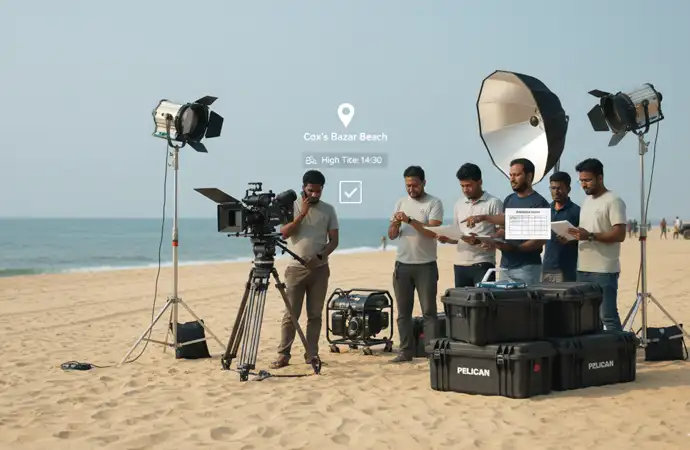
Libanza Films provides professional film fixer services in Cox's Bazar for international documentary filmmakers, broadcasters, journalists, NGOs, environmental organisations and foreign production houses. Film fixer support starts from USD 2,000. Ministry of Information filming permits take 10 to 21 working days. RRRC permits for Rohingya camp access take 2 to 3 additional weeks and are applied for in parallel with the MoI permit. Named Cox's Bazar productions supported include the documentary by María José, an independent audiovisual producer from Ecuador, for whom Libanza Films provided full on-ground production support including coastal location access, community liaison and logistics.
Cox's Bazar is globally recognised for the world's longest natural sea beach, rich coastal ecosystems, fishing communities, the largest refugee settlement on earth, and proximity to ecologically sensitive marine zones. These elements make it the most internationally documented location in Bangladesh. Filming here requires specialised local knowledge: coastal regulations, marine safety, weather dependency, layered authority permissions and community coordination make a professional local film fixer essential for any foreign production.
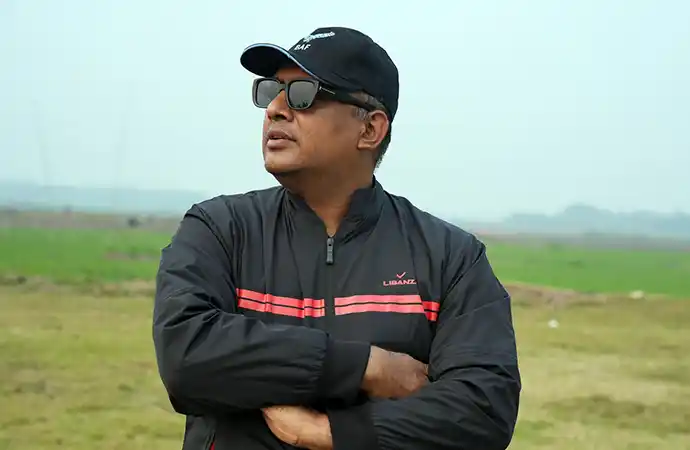
Led on the Ground by Azizul Hoque Shiplu, Founder and Film Director
Cox's Bazar productions Libanza Films supports are overseen by Azizul Hoque Shiplu, Founder and Film Director, with over two decades in advertising and film production and direct personal oversight of more than 100 advertising and audiovisual projects, including sensitive coastal and humanitarian-context productions. He began his career at Ogilvy and Mather and holds a diploma in filmmaking from the Zahir Raihan Film Institute. Read Azizul's full profile
Why Cox's Bazar Is a Prime Location for International Shooting
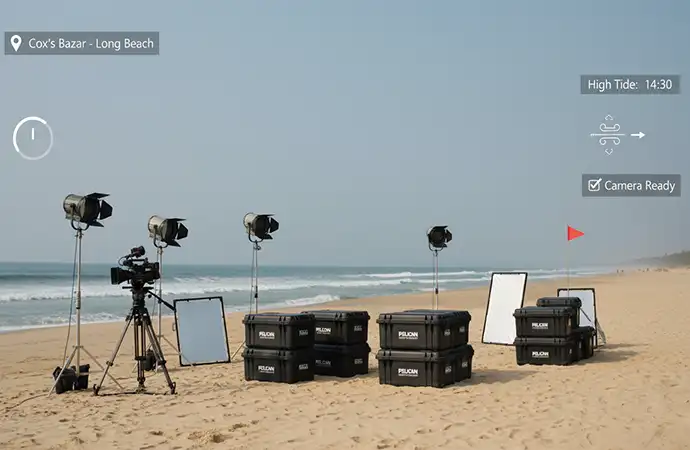
Coastal and Marine Visual Diversity
Cox's Bazar offers beaches, fishing harbours, coastal villages, tourism zones, marine transport routes and river-sea intersections. This diversity supports documentaries, climate films, tourism campaigns and humanitarian storytelling at a scale and visual quality unavailable anywhere else in Bangladesh.
Environmental and Climate Storytelling Hub
The region is the primary Bangladesh location for climate change, disaster resilience, marine conservation and humanitarian narratives. NGOs, INGOs, UN agencies and international broadcasters regularly produce here.
Strategic Access to Southern Bangladesh
Cox's Bazar serves as the gateway to southern coastal regions, islands and marine zones, making it operationally strategic for multi-location international shoots. Dhaka to Cox's Bazar is 45 minutes by domestic flight.
Why You Need a Film Fixer in Cox's Bazar
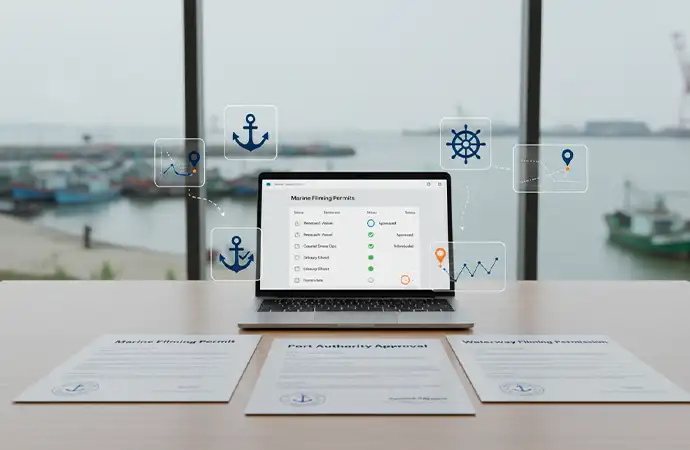
Cox's Bazar is not an open filming zone for foreign crews. Beach areas, marine routes, refugee-adjacent zones, ports and coastal communities each require permissions from different authorities. A crew that arrives without pre-arranged permits and a local fixer will be stopped before filming begins.
Libanza Films acts as your local authority liaison, coastal logistics planner and on-ground fixer — preventing delays, access issues and regulatory risks while keeping your production schedule intact.
Filming in the Rohingya Camps: The RRRC Permit Process
Cox's Bazar is home to the world's largest refugee settlement. Kutupalong and Balukhali in Ukhiya upazila host over one million refugees, making this the most internationally documented humanitarian story in South Asia. Access for foreign film crews requires a permit from the Refugee Relief and Repatriation Commissioner (RRRC) — a separate government authority from the Ministry of Information, with its own application process and approval criteria.
The RRRC permit is issued alongside — not instead of — the standard Ministry of Information coastal filming clearance. Both must be in hand before filming inside the camps begins.
What the RRRC Application Requires
- Full project description including editorial purpose and intended distribution
- Complete crew list with passport details and organisational affiliations
- Specific camp blocks or areas where filming is planned (GPS coordinates preferred)
- Safeguarding protocol documentation for filming with vulnerable communities
- Consent procedures for filming individual refugees, including children
- Ministry of Information permit (applied for in parallel — not required first)
- NGO or UN agency letter of support (strongly recommended — significantly aids approval)
RRRC Permit Practical Realities
Processing Time
2 to 3 weeks from complete application submission. Incomplete applications restart the clock. Libanza Films prepares the full documentation pack before submitting to avoid processing delays.
Approval Assessment
Approval is not automatic. RRRC assesses editorial content, organisational credibility and safeguarding approach. Productions with humanitarian or development purposes are more readily approved than investigative or adversarial editorial approaches.
Government Escort
Government liaison officers may accompany filming inside camp areas. Libanza Films coordinates this liaison and briefs international crews on appropriate conduct and communication with escort officers during the shoot.
Community Liaison
The RRRC permit gives legal access to camp areas. It does not give access to individual refugees. Libanza Films coordinates community liaison including NGO introductions, community leader engagement and translators with Rohingya dialect familiarity.
Safeguarding Requirements — Not Optional
Any production filming inside the camps must comply with:
- Individual informed consent from every person filmed, in a language they understand, explained by a qualified interpreter
- Specific consent for filming children — parental consent required and in some cases NGO child protection officer involvement
- No filming that could identify individuals to Myanmar authorities or put family members still in Myanmar at risk
- Data protection for all footage involving identifiable individuals, covering storage, transmission and final editorial use
Libanza Films provides pre-production safeguarding briefing for all camp productions and can arrange child protection officer consultation.
Cox's Bazar Permit and Access Timelines at a Glance
General coastal filming permit (Ministry of Information)
10 to 21 working days
Rohingya camp access (RRRC permit)
2 to 3 weeks (parallel with MoI permit)
CAAB drone permit
3 to 4 weeks after MoI permit received
Journalist visa pre-clearance
2 to 4 weeks
Marine and security-sensitive zones
Additional clearance — add 1 to 2 weeks
Recommended total lead time (beach + camp + drone)
6 to 8 weeks minimum
Typical ranges based on productions Libanza Films has directly supported in Cox's Bazar. We confirm a specific schedule once we have your production brief. | Full filming permits guide | Drone filming permits guide
Who Needs a Film Fixer in Cox's Bazar?
- International documentary filmmakers
- Environmental and climate research teams
- NGOs, INGOs and humanitarian organisations
- Foreign journalists and international broadcasters
- Tourism and destination marketing agencies
- Foreign production houses filming coastal stories
- Diaspora filmmakers from the UK and USA returning to produce
If your production involves foreign crew members, coastal access, camp-adjacent locations or marine visuals, professional fixer support in Cox's Bazar is essential.
What a Film Fixer Does in Cox's Bazar
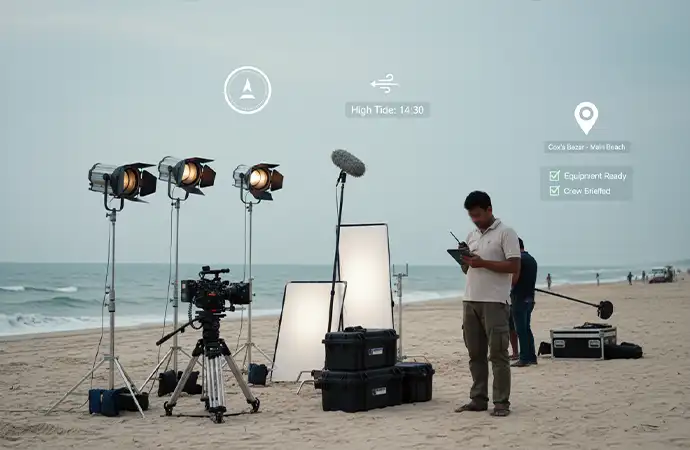
- Ministry of Information filming permit application and management
- RRRC permit for Rohingya camp access — full documentation preparation
- CAAB drone permit management for aerial footage
- Local administration, coast guard and security coordination
- Media, journalist and filming visa guidance and invitation letters
- Community and stakeholder liaison for camp-based productions
- Safeguarding briefing and consent protocol support
- Marine safety and logistics planning
- Weather-based shoot scheduling and contingency planning
- Local crew: camera operator, sound recordist, PA, translator with camp dialect
- Marine transport and boat hire with experienced local operators
- On-site supervision and real-time troubleshooting throughout filming
Location-Specific Filming Challenges in Cox's Bazar
- Unpredictable weather and tidal conditions affecting shoot windows
- Layered permit authority — MoI, RRRC, CAAB, coast guard, Forest Department for different zones each require separate coordination
- Security-sensitive areas requiring police or naval presence
- Seasonal tourism crowd pressure at peak beach locations
- Limited daylight windows for marine shooting — pre-dawn to morning only for fishing harbour content
- Logistics constraints outside Cox's Bazar town for Ukhiya and Teknaf camp-based productions
- Drone flight restrictions around the airport, naval installations and camp perimeters
Libanza Films plans proactively to manage these variables and protect your production timeline.
How Much Does a Film Fixer Cost in Cox's Bazar?
Film fixer costs in Cox's Bazar vary by engagement type, duration, crew size and the extent of marine or humanitarian-zone logistics required. Based on typical international productions Libanza Films has supported here:
- Fixer-only support: USD 2,000 to 8,000 — your crew, your direction. We handle all permits including RRRC coordination, coastal authority liaison, community access and on-ground fixer presence throughout the shoot.
- Hybrid support: USD 5,000 to 15,000 — you bring your director and key creative. We supply local DP, camera operator, sound recordist and production assistant alongside full fixer coordination.
- Full line production: USD 8,000 to 25,000+ — we execute the entire Cox's Bazar shoot on your brief, from RRRC permits through filming and delivery.
RRRC permit coordination, marine transport and community liaison for camp-area productions are priced separately and confirmed once we have your production dates and crew size — itemised, no hidden costs.
How much does a film fixer cost in Bangladesh? Full cost guide
Film Fixer Services Included in Cox's Bazar
- Ministry of Information filming permit and coastal authority clearance
- RRRC permit application for camp access — full documentation preparation
- CAAB drone permit management for aerial footage
- Journalist and media visa assistance and invitation letters
- Marine and beach location access coordination
- Community liaison and NGO introduction for camp-based productions
- Local crew, translators with camp dialect, and fixers on the ground
- Marine transport, boats, accommodation and logistics
- Security and risk management throughout the shoot
- On-ground supervision and compliance control every shoot day
These services integrate seamlessly with our Film Fixer in Bangladesh national service and our Filming Permits and Visa Guidance service.
International Productions Libanza Films Has Supported in Cox's Bazar
Libanza Films has provided film fixer and production support for international teams filming specifically in Cox's Bazar, including documentary filmmakers arriving from outside Bangladesh to document the coastline and the humanitarian response in the area.
ECUADOR | DOCUMENTARY
María José
Independent audiovisual producer, Ecuador. Documentary filmed at
Cox's Bazar. Full on-ground production support including location
access, logistics and local crew coordination throughout the shoot.
NGO | INGO EXPERIENCE
UN Agencies and INGOs
Team production experience on UNICEF, UNFPA, WaterAid, BRAC and
Save the Children productions in Bangladesh, including humanitarian
documentation in Cox's Bazar.
For the complete list of international productions Libanza Films has supported across Bangladesh, see our Film Fixer in Bangladesh hub page.
Why International Crews Choose Libanza Films in Cox's Bazar
- Proven experience managing RRRC applications and camp-based productions
- Established authority coordination across coastal, marine and humanitarian zones
- English-speaking production managers who communicate at international pace
- Transparent documentation and compliance workflows aligned to donor and broadcaster standards
- Demonstrated ability to manage sensitive humanitarian environments with ethical production practice
- Scalable support — from single filmmaker to large multi-crew productions
- Nationwide capability: Cox's Bazar productions can extend to Dhaka, Sundarbans, Sylhet or Chittagong under the same production support umbrella
Film Fixer Cox's Bazar — Frequently Asked Questions
Yes. Filming inside the Rohingya camps requires a separate RRRC permit from the Refugee Relief and Repatriation Commissioner — separate from and in addition to the Ministry of Information filming permit. The RRRC permit takes 2 to 3 weeks and requires project description, crew list, specific camp blocks, safeguarding protocols and consent procedures. An NGO letter of support significantly strengthens the application. Libanza Films manages the complete RRRC process.
Ministry of Information filming permits take 10 to 21 working days. RRRC permits for camp access take 2 to 3 additional weeks in parallel. CAAB drone permits take 3 to 4 weeks after the MoI permit is received. Marine and security-sensitive zones add 1 to 2 weeks. Total recommended lead time for a production combining beach, camp and drone filming is 6 to 8 weeks minimum.
Fixer-only support starts from USD 2,000 to 8,000. Hybrid support with local crew runs USD 5,000 to 15,000. Full line production starts from USD 8,000 to 25,000 and above. RRRC permit coordination, marine transport and Dhaka-to-Cox's Bazar logistics are priced separately. Libanza Films provides itemised estimates within 48 hours of receiving your brief.
No. Foreign productions filming on Cox's Bazar beach, the fishing harbour or nearby coastal areas require permissions from local administration and in some cases coast guard coordination. Arriving without pre-arranged access and a local fixer routinely results in filming being stopped by local authorities.
Yes. Cox's Bazar requires permissions from multiple authorities including local administration, coast guard for marine areas, RRRC for camp-adjacent zones and CAAB for drone footage. An experienced local fixer prevents costly delays, access refusals and permit failures. Fixer-only support starts from USD 2,000.
October to March offers the best conditions: calm seas for marine filming, clear skies for coastal cinematography, lower humidity and access to Saint Martin's Island (November to May). The monsoon from June to September limits marine access but provides dramatic weather visuals and is essential for productions covering camp flooding or coastal erosion stories.
Drone filming requires CAAB approval (3 to 4 weeks after the MoI permit is received). Restricted zones include the airport exclusion area (5km radius around Cox's Bazar Airport), naval installations and the Rohingya camp perimeters. Libanza Films manages CAAB drone permit applications for Cox's Bazar productions. See the complete drone filming permits guide.
Camp productions must comply with: individual informed consent in the subject's own language, parental consent for filming children, no filming that could identify individuals to Myanmar authorities, and data protection for all identifiable footage. Libanza Films provides pre-production safeguarding briefing and can arrange child protection officer consultation where required.
Talk to a Film Fixer in Cox's Bazar
Planning a coastal documentary, marine shoot, NGO project or camp-based production in Cox's Bazar? Share your production brief, planned dates and crew size. Libanza Films returns a full permit timeline and itemised cost estimate within 48 hours.
Related Guides and Services
- Cox's Bazar as a Filming Destination: Complete Guide for Foreign Crews (2026)
- How to Hire a Film Fixer in Bangladesh: The Complete Guide (2026)
- Filming Permits in Bangladesh: Step-by-Step Guide for Foreign Crews
- Drone Filming Permits in Bangladesh: Complete Guide (2026)
- NGO and Documentary Filming in Bangladesh: What Foreign Teams Should Know
- Filming in Bangladesh from the UK and USA: Guide for Diaspora Filmmakers (2026)
- How Much Does It Cost to Film in Bangladesh? (2026 Guide)
- How Much Does a Film Fixer Cost in Bangladesh?
- Safety, Security and Risk Management for Filming in Bangladesh
- Film Fixer vs Production Company: What International Crews Actually Need
- Film Fixer in Bangladesh — Full National Coverage and Pricing
- Filming Permits and Visa Guidance Bangladesh
- Documentary Production in Bangladesh
- NGO Video Production in Bangladesh
Film Fixer Coverage Across Bangladesh
Cox's Bazar is one of five major filming regions Libanza Films covers nationally. All multi-location productions are coordinated under a single plan:
- Film Fixer in Dhaka — permits, Old Dhaka access, broadcast news, commercial and NGO productions
- Film Fixer in Sundarbans — Forest Department permits, boat logistics, wildlife and climate documentary
- Film Fixer in Chittagong — ship-breaking yards, port industrial access, CHT gateway permit coordination
- Film Fixer in Sylhet — tea gardens, Ratargul Swamp Forest, haor wetlands, rural community documentary
- Film Fixer in Bangladesh — full national coverage, all pricing tiers, complete international client list
Customer Reviews

Very dedicated team! Apprecite their enthusiasm, creativity and passion for their work... Read Md. Jamil Hossain Chowdhury Rahat's Full ReviewRead More


Libanza specializes in creating captivating films and advertisements with compelling narratives and stunning visuals... Read Riad Full ReviewRead More
Get in Touch
Our Clients
Diverse industries, trusted partnerships. From advertising agencies to corporate entities and non-profit organizations, our clients rely on us to bring their creative visions to life. With passion, expertise, and attention to detail, we deliver exceptional video production solutions that exceed expectations. Join our esteemed clientele and experience the power of captivating storytelling with Libanza Films.