
How AI Content Production Works

How does AI content production work?

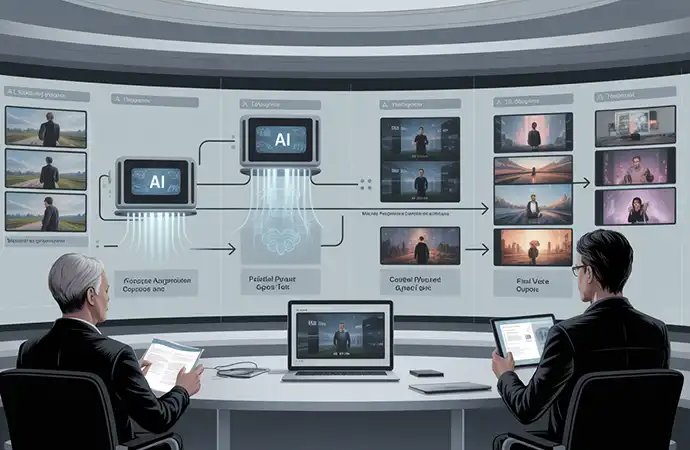
AI content production works in six stages: (1) strategy and brief definition, (2) script development with human editorial review, (3) AI generation of video, voice or visuals, (4) human compliance and accuracy review, (5) client approval with documented sign-off, (6) multi-format delivery and update-ready deployment. AI handles the generative work. Humans retain accountability at every stage that carries legal, reputational or operational consequence.

AI has permanently changed the economics of content production. Video, synthetic voice, training modules, multilingual localisation, performance ad creative — all are now achievable faster and at lower per-unit cost than traditional production allows.

But understanding how AI content production actually works — what AI genuinely does well, where human oversight is required, how compliance is managed and why the workflow is fundamentally different from pressing a button — is the prerequisite for deploying it responsibly at enterprise scale.

Discuss AI Content Production AI Content Hub
How AI content production works — six stage workflow from brief to delivery

What AI Content Production Actually Means

AI content production is the use of artificial intelligence to assist in generating, adapting or scaling content outputs — with human oversight retained at every stage where decisions carry consequence.

The AI tools used in professional content production include: language models for script drafting and localisation; voice synthesis for narration and dubbing; video generation and AI avatar systems for presenter-led content; image generation for visual assets; and AI-assisted audio tools for music and jingle production.

What professional AI content production is not: a self-service tool that autonomously creates distributable content. The outputs of AI generation require human review, editorial refinement and formal approval before they are suitable for enterprise, commercial, government or regulated-sector distribution.

The distinction matters. AI self-service tools generate outputs without structured human review — suitable for internal drafts and low-stakes content where errors carry limited consequence. Professional AI content production applies AI generation within a human-led workflow with defined review stages, compliance checkpoints and documented approval — the standard required for commercial distribution, regulated sector content and enterprise deployment.

AI content production — what AI tools do and where human oversight applies

What AI Handles vs What Humans Control

The most practical way to understand AI content production is to be clear about which work AI does well and which decisions must remain with humans:

AI handles Humans control
Script draft generation at speed Strategy, brief definition and objective setting
Synthetic voice generation and narration Factual accuracy verification and claim substantiation
Video assembly and avatar presentation Regulatory and compliance review per market
Multi-language voice adaptation and dubbing Language specialist review in each target language
Multi-format and multi-platform export Brand tone, voice register and cultural appropriateness
Version management and update implementation Final approval sign-off and audit documentation
Image generation and visual asset production Distribution authorisation and compliance disclosure

The division is consistent across all content types: AI handles the mechanical and generative work that can be produced at speed and scale. Humans handle the decisions that carry legal, reputational or operational consequence.

The Six-Stage AI Content Production Workflow

At Libanza Films, every AI content production programme — regardless of content type, market or language — follows a structured six-stage workflow:

Stage 1 — Strategy & Governance Anchor

Human-led brief definition establishes content purpose, target audience, platform requirements, regulatory context, compliance requirements and the approval hierarchy for this programme. AI generation only begins against a brief that has been formally approved by the relevant human stakeholders. The brief is the governance anchor for the entire workflow.


Stage 2 — Script & Human Editorial Review

AI accelerates initial scripting from the approved brief. Human editorial review then refines AI-generated scripts for factual accuracy, claim substantiation, regulatory terminology, brand tone and appropriate register before any AI generation of visuals, voice or video begins. This is the cheapest point in the workflow to catch and correct errors — before they are built into produced assets.

Stage 3 — AI Generation

AI tools generate video, synthetic voice, visual assets, music, multi-language adaptations or multi-format outputs against the human-approved script and brief. This is where AI delivers its primary speed and scale advantage — producing at machine speed from human-approved inputs, toward human-reviewed outputs. The generation stage does not make decisions; it executes against approved parameters.

Stage 4 — Human Review & Compliance Check

Human reviewers — including subject-matter experts, language specialists and compliance reviewers where required — verify AI-generated outputs against regulatory requirements, platform policies, accuracy standards and brand guidelines. For multilingual content, each language version is reviewed by a human specialist in that language. For regulated sector content, human compliance reviewers apply sector-specific codes. No outputs advance without passing this stage.

Stage 5 — Client Approval & Documentation

Client review, feedback rounds and formal approval with documented sign-off at the output stage. This creates the audit trail demonstrating responsible AI use — essential for EU AI Act Article 50 compliance, enterprise procurement requirements and regulated sector governance documentation. The governance record shows which human approved which content, at which stage, against which brief.

Stage 6 — Delivery, Deployment & Updates

Final approved content delivered in required formats — LMS/SCORM for training, broadcast specs for advertising, digital platform specs for performance content, or multilingual variant packages for international deployment. AI-assisted updates when requirements change: regulation updates, product changes, policy revisions — implemented without full reshoots and with the same human review stages applied to the changed elements.

AI Content Production vs Traditional Production — Speed & Cost

AI content production vs traditional production — speed and cost comparison

The practical case for AI content production in enterprise contexts is not about replacing human creativity — it is about eliminating the mechanical cost and time constraints of traditional production:

Task Traditional AI-Assisted
Training module (10 min) 4–6 weeks 1–2 weeks
EN → 5 language localisation 5 separate shoots 1 master + AI adaptation
Policy/compliance update Partial or full reshoot AI update in hours–days
Ad creative variations (×10) 10 separate productions AI variations from 1 shoot

Traditional production remains the right choice for flagship brand storytelling, high-production broadcast campaigns and content where cinematic quality is the primary requirement. AI production is the right choice for training, compliance, corporate AV, multilingual localisation, performance marketing variation and any content that will need regular updates. The two models are often combined within a single programme.

For a detailed comparison, see: AI vs Traditional Video Production

What AI Content Production Can Create

AI Video Content

AI-generated and AI-assisted video — avatar-led presenter content, product explainers, brand films, corporate AV and performance marketing ads. Human review at script and output stages before any distribution approval.

AI Training & Avatar Videos

AI avatar-presented training modules, onboarding programmes, compliance training and e-learning content — SCORM and LMS compatible, updateable without reshooting. Human subject-matter expert review for accuracy.

AI Dubbing & Localisation

Multilingual AI dubbing, subtitle generation and lip-sync adaptation for existing video content. Human language specialist review in each target language — Arabic (MSA and Khaliji), French, German, Italian, Spanish, Dutch and more.

AI Performance Marketing Content

High-volume AI-generated ad creative variations for digital performance marketing — Meta, YouTube, LinkedIn and CTV-ready. Multiple variations from a single brief, with FTC/ASC/ASA-aware disclosure documentation for commercial distribution.

AI Music & Jingle Production

AI-assisted music composition and brand audio — jingles, background scores, theme music and brand anthems. Human music production oversight for brand tone, genre consistency and commercial clearance suitability.

AI Image Generation

AI-generated visual assets for brand content, training illustrations, presentation decks and digital communication. Human creative review for brand consistency, accuracy and appropriate representation standards.

AI content production governance and compliance framework — human review and audit documentation

Compliance & Governance Built Into the Workflow

The compliance requirements that apply to AI content production vary by market, sector and content type — but they share a common structure: human specialist review at the output stage is required before distribution. AI generation alone cannot satisfy them.

  • EU AI Act Article 50 (all 27 EU member states): AI-generated synthetic speech and AI-manipulated video likenesses in content likely to be mistaken for authentic must be disclosed and labelled. Libanza Films provides disclosure documentation and synthetic content metadata as a standard deliverable for all EU distribution content.
  • Advertising standards (ASA/CAP, FTC, Werberat, ASC): Commercial AI content is subject to advertising standards that require accuracy, claim substantiation and non-deceptive representation. Human review at the output stage applies these standards before any commercial distribution.
  • Sector-specific codes (pharmaceutical, financial, healthcare): FDA DDMAC fair balance requirements, FCA financial promotions rules, BaFin-regulated content standards, HWG pharmaceutical advertising — all require human compliance specialist review that AI cannot apply at the output stage.
  • GDPR / DSGVO / data protection: AI production workflows must apply data minimisation — no personal data incorporated into AI generation pipelines without documented lawful basis. Compliance DPAs available for all enterprise clients.
  • Platform-specific disclosure (Meta, YouTube, LinkedIn): AI-generated content disclosure labels required by major platforms for commercial distribution are applied as standard for all content destined for these channels.
Full Governance Framework HITL Production Model

Explore the AI Production Ecosystem

Human-in-the-Loop AI Production

The detailed explanation of the HITL model — why enterprises cannot rely on fully automated AI, what HITL production looks like at each stage and how it differs from human-on-the-loop AI.

AI vs Traditional Video Production

Where AI-assisted production delivers clear advantages over traditional methods, where traditional production remains the right choice, and how organisations combine both models within a single content programme.

AI Content Governance & Compliance

The complete Libanza Films governance framework — how AI production workflows are structured, documented, audited and adapted to different regulatory environments across global markets.

AI Video Content Creation: Enterprise Guide 2026

The comprehensive enterprise decision-maker guide to AI video production — use cases, workflow models, compliance frameworks, ROI assessment and adoption sequencing for 2026.

Is AI Content Safe for Commercial Use?

A direct answer to the question every enterprise AI content buyer needs to answer before deployment — what makes AI content safe, what makes it unsafe, and how to tell the difference before you approve content for distribution.

AI Content Production Hub

The full Libanza Films AI content production ecosystem — country and regional market pages, service-level pages, methodology pages and blog cluster. Starting point for all AI content market and service research.

FAQs — How AI Content Production Works

AI content production works in six stages: strategy and brief definition, script development with human editorial review, AI generation of video/voice/visuals, human compliance and accuracy review, client approval with documented sign-off, and multi-format delivery with update-ready deployment. At each stage, AI accelerates execution while humans retain accountability for every decision that carries legal, reputational or operational consequence.

No. Enterprise-grade AI content production is not fully automated and should not be. Fully automated AI creates outputs without structured human review — generating accuracy, regulatory and reputational risk. Human-in-the-loop (HITL) AI production retains human review, approval and accountability at defined checkpoints. AI handles the generative workload; humans handle the decisions that carry consequence.

AI content production is significantly faster than traditional production. A training module requiring 4–6 weeks traditionally completes in 1–2 weeks with AI. Multilingual localisation requiring separate shoots in traditional production completes from a single brief with AI adaptation. Compliance and policy updates that require reshoots traditionally are implemented in hours or days with AI-assisted production.

AI content production can create: avatar-led training and onboarding videos, corporate AV, multilingual localised versions through AI dubbing and subtitle generation, performance marketing ad creative at volume, product explainers, AI-generated images for digital and print use, synthetic voice narration for e-learning, and AI-assisted music and jingles. All AI-generated outputs require human specialist review before enterprise distribution.

Quality is controlled through structured human review at defined stages: script-level editorial review before generation; output-stage compliance and accuracy review against sector-specific requirements; brand tone and language register review by human specialists; and documented client approval sign-off before distribution. Quality control is not optional in enterprise AI content production — it is what distinguishes professional AI-assisted production from self-service AI tool outputs.

AI handles: script draft generation, synthetic voice, video assembly, visual generation, multi-language adaptation, multi-format export and version management. Humans control: strategy, brief approval, factual accuracy verification, regulatory compliance review, brand tone judgment, cultural appropriateness assessment, final approval and distribution sign-off. The division is consistent: AI handles generative work at scale; humans handle decisions that carry consequence.

Compliance is handled through human specialist review at the output stage. AI generation cannot reliably assess whether outputs meet advertising standards (ASA/CAP, FTC, Werberat), pharmaceutical codes (FDA DDMAC, HWG), financial regulations (FCA, FINRA, BaFin), EU AI Act Article 50 disclosure requirements or sector-specific codes. These require human compliance reviewers — not AI quality checks. Libanza Films applies market-specific compliance review for all global markets served.

Yes. Multilingual scale is one of AI content production's primary commercial advantages. A single English master can be localised into multiple languages simultaneously through AI-assisted dubbing and subtitle generation — with human language specialist review in each target language before delivery. For organisations managing content across the EU (24 official languages), GCC (Arabic Khaliji across 6 countries) or global enterprise networks, AI-assisted localisation enables multilingual deployment at a fraction of traditional multi-language production cost and timeline.

Ready to Deploy AI Content Production?

AI content production works best when structure, governance and human expertise are built into the workflow from the start — not added as an afterthought after automated AI tools have already created compliance, accuracy or reputational risk.

Libanza Films delivers human-led AI content production for enterprise, government, SaaS, FMCG, pharmaceutical, financial services, NGO and regulated-sector organisations globally.

Start a Project Explore AI Content Hub HITL Production
Customer Reviews

Fantastic team. They took ownership of the project. As a result, they gave very good creative inputs to improve the ad. They also tried hard to reduce the project cost... Read Ehtesham Ahmed's Full ReviewRead More

Very dedicated team! Apprecite their enthusiasm, creativity and passion for their work... Read Md. Jamil Hossain Chowdhury Rahat's Full ReviewRead More

Libanza specializes in creating captivating films and advertisements with compelling narratives and stunning visuals... Read Riad Full ReviewRead More

Get in Touch

Fields with (*) are required.

Our Clients

Diverse industries, trusted partnerships. From advertising agencies to corporate entities and non-profit organizations, our clients rely on us to bring their creative visions to life. With passion, expertise, and attention to detail, we deliver exceptional video production solutions that exceed expectations. Join our esteemed clientele and experience the power of captivating storytelling with Libanza Films.

Arrow