


Fantastic team. They took ownership of the project. As a result, they gave very good creative inputs to improve the ad. They also tried hard to reduce the project cost... Read Ehtesham Ahmed's Full ReviewRead More
Film Locations in Bangladesh: A Director's Guide for International Productions
No country of comparable size offers the visual range that Bangladesh does. Within a geography roughly the size of England, you can move from one of the world's most densely populated megacities to one of its largest mangrove wildernesses, from the longest natural sea beach on earth to remote river delta islands that flood for months each year, from industrial ship-breaking yards to tea garden hillsides that have barely changed in a century.
This range is why international documentary filmmakers, broadcast journalists, NGO communications teams and commercial directors return to Bangladesh repeatedly. The stories are here. The visual contrast is here. The subjects — climate, migration, poverty, industry, resilience, cultural identity — are not abstract. They are visible on the landscape.
This guide covers Bangladesh's most significant filming locations for international productions — what each offers visually, what kind of content it serves, what access requires and what you need to plan before you arrive. Every location in this guide has been filmed by Libanza Films or supported by our production team for international clients.
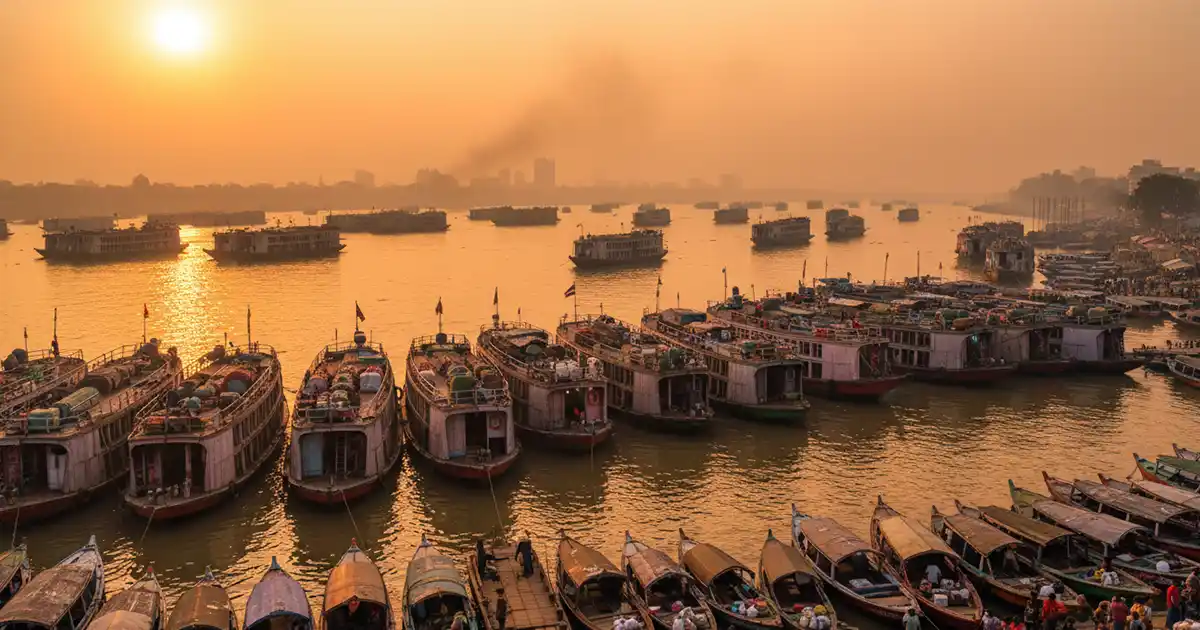
Dhaka — Megacity, Contradiction and Visual Intensity
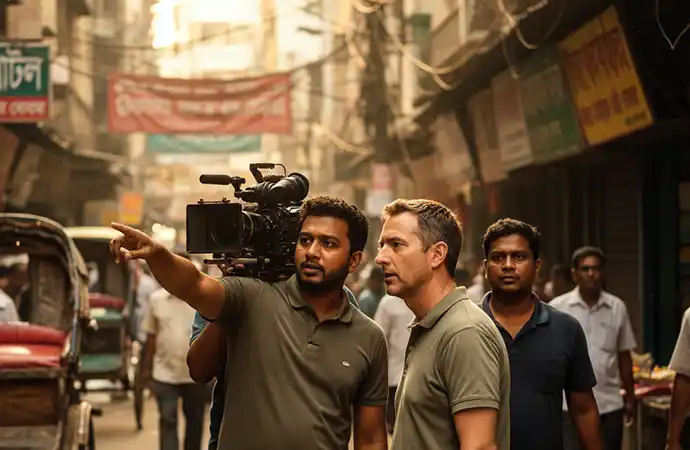
Dhaka is one of the most overwhelming cities on earth — and one of the most visually extraordinary. With a population exceeding 22 million and a density that makes Tokyo look spacious, the city produces visual content that is impossible to replicate elsewhere: rickshaw gridlock, river port chaos, garment factory production lines, centuries-old narrow bazaars running alongside glass corporate towers.
Key filming environments in Dhaka:
- Sadarghat River Port: The busiest river port in the world by vessel count. Rocket steamers, wooden launches, human ferries and cargo boats converge at a single ghat on the Buriganga River. The scale, the light on the water and the sheer volume of human activity make this one of the most cinematically rich locations in Asia. Filming requires police coordination and port authority liaison.
- Old Dhaka — Shankhari Bazaar and the Hindu quarter: A 400-year-old street lined with conch-shell artisans, centuries-old temples and architecture unchanged since the Mughal period. Narrow enough to touch both walls simultaneously, visually dense and tonally unique. Community liaison is essential — cameras attract significant crowd attention here.
- Lalbagh Fort: A 17th-century Mughal fortress in the heart of Old Dhaka, partially complete and atmospherically preserved. Government archaeological site — filming permit from the Department of Archaeology required.
- Garment factories: Bangladesh is the world's second-largest garment exporter. Factory-floor filming is among the most requested location types for international documentary and fashion industry content — and among the most restricted. Access requires direct negotiation with factory owners and in some cases BGMEA liaison. Allow four to six weeks.
- Urban slum communities (Korail, Kallyanpur): Dense informal settlements home to hundreds of thousands of internal migrants. High demand for NGO and development content. Access is strictly through community leader engagement and NGO partner coordination — never unannounced.
- Dhaka medical institutions: Several major hospitals are frequently used for health-focused documentary content. Hospital authority permission and ethics clearance required.
Access note: Dhaka requires strong local relationships to film productively. Traffic between locations routinely doubles estimated travel time — plan no more than three distinct locations per shoot day.
Cox's Bazar — Beach, Rohingya Response and Coastal Community Life
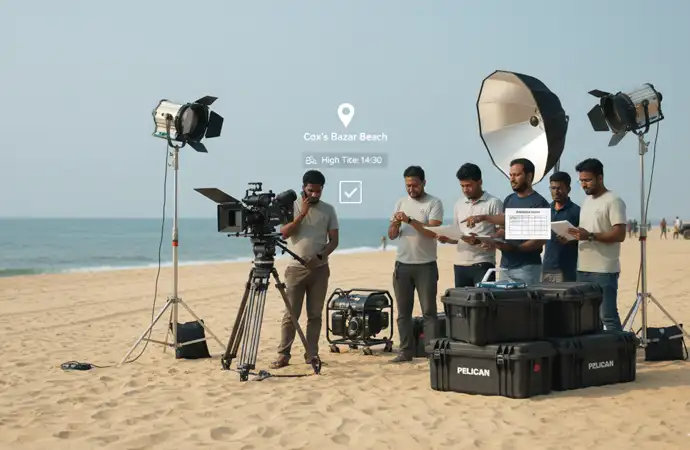
Cox's Bazar is Bangladesh's most internationally recognisable filming location — and the one most misunderstood by international productions before they arrive. The 120km natural sea beach is the longest in the world and visually commanding. But for the majority of international productions drawn to Cox's Bazar, the reason is what lies north of the beach: the world's largest refugee settlement, home to more than a million Rohingya who fled Myanmar's military violence.
Key filming environments in Cox's Bazar:
- Cox's Bazar Beach (Laboni, Himchari, Inani): The main beach at Laboni is crowded with Bangladeshi domestic tourists and fishing boats — visually busy and energetic. Himchari and Inani, 20-40km south, offer increasingly dramatic coastal scenery. Inani is particularly striking at low tide when the exposed reef stretches hundreds of metres offshore.
- Cox's Bazar fishing harbour: A working commercial harbour with wooden trawlers, nets and the full visual world of coastal fishing communities. Less photographed than the main beach and more authentic for documentary content.
- Teknaf and Marine Drive: The 80km coastal road between Cox's Bazar and Teknaf passes through salt flats, mangrove forest, fishing villages and mountains descending to the sea. One of the most visually diverse single drives in Bangladesh.
- Kutupalong and Rohingya settlements: The largest refugee settlement on earth requires a completely separate access process. RRRC permit, UNHCR, IOM and Bangladesh government approval are all required. Allow 6 to 8 weeks for access coordination. Do not attempt to film here independently.
Getting there: Multiple daily flights from Dhaka — approximately 45 minutes. Road takes 10-12 hours.
The Sundarbans — Mangrove Wilderness, Wildlife and Tidal Channels
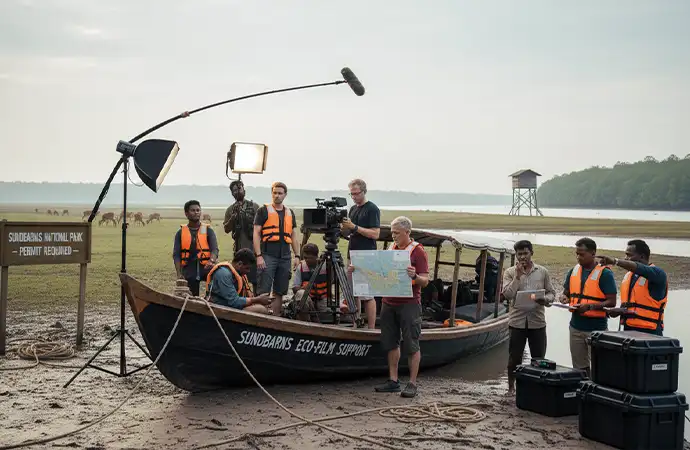
The Sundarbans is unlike any other filming location in South Asia. The world's largest mangrove delta — a UNESCO World Heritage Site — is a tidal maze of rivers, creeks and forest-covered islands where the largest population of Royal Bengal Tigers in the world lives alongside spotted deer, saltwater crocodiles, Irrawaddy dolphins and hundreds of bird species.
It is also home to the Mouali — honey hunters who enter the tiger-inhabited forest every spring with wooden boats and minimal protection to harvest wild honey, guided by traditions that are centuries old.
Key filming environments in the Sundarbans:
- Tidal channel networks: The Sundarbans has no roads. All movement is by boat through tidal rivers and narrow creeks under the forest canopy. For aerial and drone work, clearance from the Forest Department and Civil Aviation Authority is required in addition to standard filming permits.
- Wildlife: Royal Bengal Tigers are present but rarely seen — wildlife productions should not plan shoots around tiger sightings. Spotted deer, macaques, fishing cats, otters and bird life are reliably filmed.
- Mouali honey hunters: Seasonal access only — April to June. Prior community arrangement through your production partner is required; no crew contact without it.
- Coastal villages and climate communities: Delta communities at the forest edge are among Bangladesh's most climate-vulnerable populations. High demand for climate and development documentary content.
Access note: Sundarbans filming requires a Forest Department permit, Bangladesh Navy/Coast Guard clearance for overnight vessel stays and Range Officer coordination. Base is Khulna or Mongla — four to five hours from Dhaka. Allow four to six weeks for permit processing.
Chittagong (Chattogram) — Ship-Breaking, Port and the Hill Tracts Gateway
Chittagong is Bangladesh's second city and its main seaport — a city of extraordinary industrial scale and visual drama that is significantly underfilmed compared to Dhaka and Cox's Bazar.
- Sitakunda ship-breaking yards: Among the most visually dramatic industrial environments in the world. Enormous ocean-going vessels are driven ashore on the beach at high tide and manually dismantled by thousands of workers over months. Access requires direct negotiation with yard owners and in some cases coordination with the Bangladesh Ship Breakers and Recyclers Association. Expect resistance and plan for three to four weeks of access negotiation.
- Chittagong Port: The largest seaport in Bangladesh and one of the busiest in South Asia. Container terminals, bulk cargo operations and river shipping combine in a location that represents the movement of Bangladesh's entire import-export economy. Port authority permission required.
- Patenga Beach and the Karnaphuli River estuary: Where the river meets the sea at the port mouth — a working waterfront of fishing boats, cargo vessels and coastal communities with an industrial backdrop. Less visited than Cox's Bazar, more authentic for working waterfront content.
- Chittagong Hill Tracts — Rangamati, Bandarban, Khagrachari: Bangladesh's only hill country — forested mountains, indigenous ethnic minority communities (Chakma, Marma, Tripura, Bawm and others), hanging bridges, Buddhist temples and landscapes unlike anywhere else in Bangladesh. The Hill Tracts require a mandatory special permit for foreign nationals. Allow six weeks. Some areas remain off-limits to foreigners entirely.
Getting there: Multiple daily flights from Dhaka — approximately 50 minutes. Road takes 5-6 hours.
Sylhet — Tea Gardens, Wetlands and Spiritual Landscapes
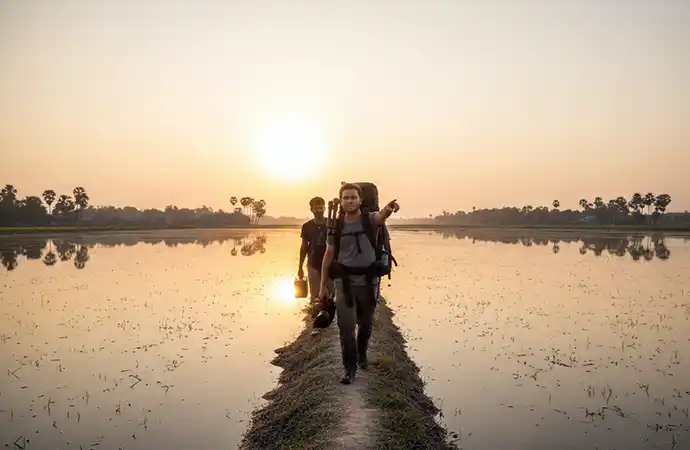
Sylhet in northeast Bangladesh is the country's most visually gentle landscape — rolling tea-covered hills, ancient wetlands that flood to form inland seas in the wet season and a spiritual geography shaped by centuries of Sufi tradition. It is also the origin region of the majority of the British Bangladeshi community, making it of particular interest for diaspora documentary work.
- Tea estates — Srimangal: Bangladesh's tea-growing capital sits two hours south of Sylhet city. The estates — rolling hills of manicured tea under shade trees, with pickers in coloured saris moving through the rows — are among the most photographed landscapes in Bangladesh. Access is negotiated directly with each estate. Allow two to three weeks for access arrangement.
- Ratargul Swamp Forest: Bangladesh's only freshwater swamp forest — accessible only by boat, seasonally flooded to several metres depth. Otherworldly in the wet season. Forest Department permit required.
- Sunamganj Haor wetlands: A bowl-shaped wetland basin that floods entirely between April and October, transforming thousands of square kilometres into an inland sea dotted with villages on raised earth islands. One of the most visually arresting landscapes in South Asia and among the least filmed internationally.
- Bichanakandi: A river-boulder landscape at the Indian border where clear hill water flows over flat stone outcrops surrounded by tropical hills. Underused by international productions. No specialist permits for the public river area.
Getting there: Approximately 45 minutes by domestic flight from Dhaka. Road takes 5-6 hours.
The Padma-Jamuna Delta — Rivers, Char Islands and Climate Frontlines
Bangladesh is the delta. The country sits at the confluence of three of the world's largest river systems — the Padma (Ganges), Jamuna (Brahmaputra) and Meghna — and the landscape they create is unlike anywhere else on earth. Rivers that are two kilometres wide, char islands that appear and disappear with each monsoon, communities that relocate entire villages as riverbanks erode beneath them — this is the climate story of the 21st century told in real time.
- Char islands: Sand islands that emerge from the rivers after each flood season and disappear with the next — populated by some of Bangladesh's poorest communities. The char communities are the frontline of climate-driven internal migration content.
- Padma River ferry crossings: The Mawa–Paturia ferry crossing — still operational for commercial transport — concentrates thousands of vehicles, tens of thousands of passengers and hundreds of vessels at a single point. Still visually extraordinary.
- The Brahmaputra corridor — Jamalpur and Sherpur: The widest river corridor in Bangladesh, where the Jamuna floods laterally for up to 20km in the monsoon season. Fishing communities, seasonal agriculture and the visual scale of the flooding are significant for climate and agricultural documentary content.
- Mongla and the Khulna delta: The port town of Mongla sits at the edge of the Sundarbans. The surrounding mangrove-edge landscape — shrimp farms, saline-water communities, coastal erosion — documents Bangladesh's delta at its most vulnerable.
Delta filming requires boat logistics, flexible scheduling around tidal windows and acceptance that road access disappears entirely in the monsoon season. A local production partner who knows the river systems is not optional for this territory.
Rural Bangladesh — Village Life, Agriculture and Community Stories
Sixty percent of Bangladesh's population lives in rural areas. The visual world of Bangladesh's villages — mustard fields in winter, rice paddies flooded in the monsoon, weavers at hand looms, riverside market days, school children crossing paddies on narrow raised paths — is the backdrop to the majority of the country's development work and the subject of more international NGO and documentary content than any urban environment.
- Agriculture: Bangladesh's cropping calendar creates dramatically different visual environments through the year. October to January is mustard season in the north. February to April is the boro (winter rice) harvest. June to September is monsoon — paddies flooded, boats replacing roads in low-lying areas.
- Handloom weaving — Tangail and Rajshahi: The jamdani weaving workshops of Narayanganj (a UNESCO Intangible Cultural Heritage) and the Rajshahi silk district are the most accessible for production purposes.
- Health and education facilities: Rural health clinics, community clinics and primary schools are among the most commonly required locations for NGO and development documentary content. These require both institutional permission and community leader engagement.
- Village access in general: A camera in a village that does not know you are coming will draw a crowd that makes filming impossible within ten minutes. Community liaison, arranged in advance through your production partner, is the prerequisite for productive rural filming in Bangladesh.
Restricted and Sensitive Filming Locations in Bangladesh
Several categories of location in Bangladesh require specific advance clearances beyond standard filming permits. International crews should understand these before planning schedules around locations that may not be accessible.
- Military establishments and cantonment areas: Completely off-limits to foreign production crews without direct Ministry of Defence authorisation. This is rarely granted and takes months when it is. Perimeter filming from public roads is generally permitted without special clearance.
- Border zones: Bangladesh's land borders with India and Myanmar require prior clearance for any filming activity within several kilometres of the border line. Teknaf, adjacent to the Myanmar border, has specific restrictions.
- Rohingya settlements — Cox's Bazar: RRRC permit and INGO coordination required. No independent access for foreign productions. Allow 6 to 8 weeks.
- Chittagong Hill Tracts: Mandatory special permit for foreign nationals — applied to all visitors, including film crews. Coordinate through your local production partner with a minimum six-week lead time.
- Industrial sites (garment factories, ship-breaking yards, ports): Individually controlled access — no general permit covers these. Each requires direct negotiation with the operating company or authority.
Location Planning: What International Productions Get Wrong
Based on our experience supporting international productions across Bangladesh, the location planning errors that most commonly cause problems are:
- Assuming permit timelines are predictable: Government processing times in Bangladesh are influenced by political calendars, public holidays, departmental workload and the relationship your fixer has with relevant officers. Plan for the worst-case timeline, not the best case.
- Scheduling too many locations per day: Dhaka traffic, Bangladesh's road infrastructure outside major cities and the community liaison time required for rural filming all make multi-location days far less productive than they appear on paper.
- Underestimating community access preparation: International crews frequently assume that a filming permit from a government ministry grants access to the community being filmed. It does not. Community consent is a separate process managed through local leaders.
- Treating the monsoon as a dead season: The monsoon (June–September) creates some of Bangladesh's most visually distinctive environments — flooded haors, swollen rivers, delta islands submerged to roof height. Productions that plan for this season can capture content unavailable at any other time.
- Not planning for the Chittagong Hill Tracts permit: This is the single most common scheduling failure. The CHT permit is a legal requirement for all foreign nationals — not optional, not negotiable, not possible to obtain on arrival. Productions that discover this on the day they planned to travel lose those shoot days entirely.
Frequently Asked Questions — Film Locations in Bangladesh
Bangladesh's most compelling filming locations include Old Dhaka (Sadarghat river port, Lalbagh Fort, Shankhari Bazaar), Cox's Bazar (world's longest natural sea beach and Rohingya settlements), the Sundarbans mangrove delta, Chittagong's ship-breaking yards, Sylhet tea gardens and haor wetlands, and the Padma-Jamuna river delta. Each location requires different permits and logistics planning. Libanza Films provides production support across all of these regions.
Yes. Most filming locations in Bangladesh — particularly government sites, industrial areas, rural communities, refugee settlements and restricted zones — require permits and access coordination that an international crew cannot manage independently. A local film fixer with established authority relationships is essential for accessing the majority of compelling filming environments in Bangladesh. Film fixer support starts from USD 2,000 to 8,000 for fixer-only engagements.
The Rohingya settlements in Cox's Bazar require RRRC permit and INGO coordination — allow 6 to 8 weeks. Chittagong ship-breaking yards require owner and association permission — 4 to 6 weeks. The Sundarbans requires Forest Department permits — 4 to 6 weeks. The Chittagong Hill Tracts require a mandatory foreign national special area permit — 6 to 8 weeks minimum. Military establishments and border zones require the longest lead times and are often inaccessible without specialist facilitation.
About the Author
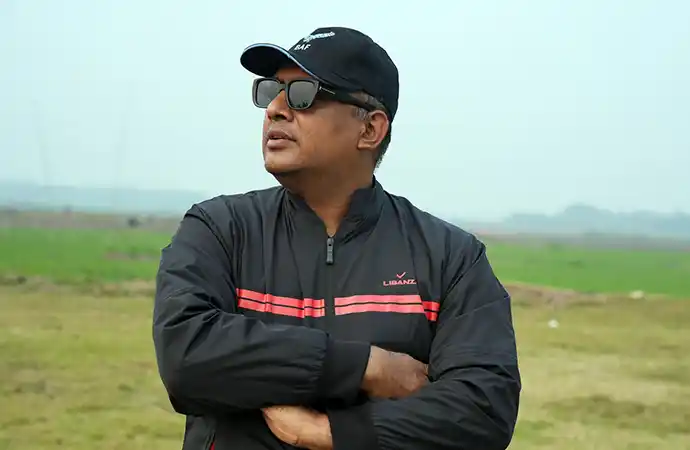
Azizul Hoque Shiplu
Founder and Film Director of Libanza Films. Azizul has worked in commercial film production and advertising since 2007, beginning his career at Ogilvy and Mather and training at the Zahir Raihan Film Institute. He has personally filmed at or managed production access to every location described in this guide — Sadarghat, the Rohingya camps, the Sundarbans, the Sitakunda ship-breaking yards, Srimangal tea estates and the haor wetlands — for international clients from the USA, UK, Belgium, Romania, Malaysia, Ecuador, Singapore, UAE, France and India. The access notes and permit timelines in this guide reflect direct experience, not secondary research.
Need a Film Fixer in Bangladesh to Access These Locations?
Libanza Films has filmed across every location in this guide — and supported international productions in accessing the permits, communities and environments that make Bangladesh one of the world's most compelling countries to document. Tell us your locations, your production type and your timeline and we will build you a complete location access and production support plan.
Related Reading
- Film Fixer in Bangladesh — Full National Coverage and Pricing
- Film Fixer in Dhaka — Sadarghat, Old City and Urban Access
- Film Fixer in Cox's Bazar — RRRC Permits, Beach and Camp Access
- Film Fixer in Sundarbans — Forest Permits, Boat Logistics and Wildlife
- Film Fixer in Chittagong — Ship-Breaking Yards and Hill Tracts Access
- Film Fixer in Sylhet — Tea Estates, Haor Wetlands and Swamp Forest
- Filming Permits and Media Visa Guidance in Bangladesh
- How to Hire a Film Fixer in Bangladesh: The Complete Guide (2026)
- Drone Filming Permits in Bangladesh: Complete Guide (2026)
- Filming in Bangladesh from the UK and USA: Guide for Diaspora Filmmakers (2026)
- Filming Permits in Bangladesh Explained: Step-by-Step Guide for Foreign Crews
- How Much Does a Film Fixer Cost in Bangladesh? (2026 Guide)
- Cox's Bazar as a Filming Destination: Complete Guide for Foreign Crews (2026)
- International Production Support in Bangladesh: What Foreign Production Companies Need to Know
- NGO and Documentary Filming in Bangladesh: What Foreign Teams Should Know
Customer Reviews

Very dedicated team! Apprecite their enthusiasm, creativity and passion for their work... Read Md. Jamil Hossain Chowdhury Rahat's Full ReviewRead More


Libanza specializes in creating captivating films and advertisements with compelling narratives and stunning visuals... Read Riad Full ReviewRead More
Get in Touch
Our Clients
Diverse industries, trusted partnerships. From advertising agencies to corporate entities and non-profit organizations, our clients rely on us to bring their creative visions to life. With passion, expertise, and attention to detail, we deliver exceptional video production solutions that exceed expectations. Join our esteemed clientele and experience the power of captivating storytelling with Libanza Films.